

Summary for Decision-Makers
Choosing between a web application development firm and an in-house team is not simply a comparison between an external hourly rate and an employee salary. The decision affects how quickly the business can assemble the required capabilities, who controls product and technical decisions, how knowledge is retained, and which delivery risks the organization must manage.
A development firm is often the stronger option when speed, specialized expertise, flexible capacity, or a defined delivery window matters most.
An in-house team is often better when the application represents core intellectual property and requires continuous product discovery and development over many years.
Total cost should include recruitment, benefits, management, tools, unused capacity, vendor governance, transition, and long-term maintenance.
External delivery does not require giving up product ownership. A business can retain control of its roadmap, data, source code, architecture principles, and release decisions.
A hybrid model can combine internal product authority with external engineering capacity, but responsibilities and knowledge transfer must be designed from the beginning.
Introduction
Once a business decides to build a custom web application, another strategic question follows: should it recruit an in-house team or engage a specialized web application development firm?
Both approaches can produce secure, scalable software. Both can also fail when the model does not fit the product, timeline, internal capabilities, or risk profile. A firm may provide faster access to a complete engineering team, but the client still needs strong product ownership. An internal team may offer deeper institutional knowledge, but recruiting every required capability takes time and creates fixed costs.
This guide focuses specifically on the model-selection decision. It compares the two approaches across four practical dimensions: cost, control, speed, and risk. It also explains when a firm, an in-house team, or a hybrid structure is most appropriate and provides a decision scorecard for technology and business leaders. If an external model has already been selected, our separate guide to the benefits and risks of outsourcing web application development examines supplier-side opportunities, delivery risks, and mitigation practices in greater depth.
What Is a Web Application Development Firm?
A web application development firm is an external company that plans, designs, builds, tests, deploys, and may continue to maintain browser-based software for clients. Depending on the engagement, the firm may provide business analysts, UI/UX designers, frontend and backend developers, solution architects, QA engineers, DevOps specialists, security expertise, and delivery management as one coordinated team.
This differs from hiring a freelancer or adding developers through staff augmentation. A freelancer usually owns a defined piece of work, while staff augmentation adds people to a client-managed team. A development firm can assume broader accountability for delivery outcomes, engineering coordination, quality, and the application lifecycle.
An in-house team consists primarily of employees working under the organization’s management structure. The company recruits the roles, establishes the engineering environment, manages performance, retains knowledge, and carries the ongoing cost of the team.
Neither structure is automatically superior. Their advantages depend on the business context.
Decision Comparison: Development Firm vs In-House Team
Decision factor | Development firm | In-house team |
Initial investment | Lower recruitment and setup burden, but discovery and onboarding are still required | Recruitment, benefits, tools, leadership, and onboarding must be funded before full delivery capacity exists |
Ongoing cost | Can expand, reduce, or end with the roadmap, subject to contract terms | Becomes a continuing fixed commitment even when demand changes |
Time to start | Faster when the firm has a suitable cross-functional team available | Depends on how quickly the company can recruit and integrate every critical role |
Specialized skills | Specialists can be introduced when architecture, security, integration, performance, or QA needs arise | Expertise is limited to the people the company can recruit and retain |
Product control | Requires explicit governance, access, and decision rights | Direct managerial control, although internal misalignment can still delay decisions |
Knowledge retention | Requires documentation and continuous transfer to avoid dependency | Knowledge stays closer to the organization but remains exposed to employee turnover |
Capacity changes | Resources can often be adjusted by phase | Hiring and downsizing take longer and carry organizational consequences |
Strongest fit | Defined initiatives, capability gaps, urgent delivery, or variable demand | Core products with a stable, long-term roadmap and continuous internal ownership |
Cost: Compare Total Cost of Ownership, Not Just Rates
An hourly rate or annual salary does not represent the full cost of either model. The meaningful comparison is the total cost required to establish, operate, and sustain the delivery capability over the expected life of the product.
For an in-house team, total cost includes recruitment, salaries, benefits, equipment, software tools, cloud environments, engineering leadership, training, retention, and employee replacement. It also includes capacity that remains on payroll when intensive development moves into lighter maintenance.
The scale of non-salary costs is easy to underestimate. As a U.S. benchmark, the Bureau of Labor Statistics reported that benefits represented 30.1% of total employer compensation costs for private-industry workers in March 2026. That figure is not a universal markup for software teams or other countries, but it demonstrates why salary alone is an incomplete basis for comparison.
For a development firm, total cost includes discovery, delivery fees, client-side management, scope changes, security reviews, transition, and post-launch support. A low proposal can become expensive if assumptions are unclear, essential work is excluded, or substantial remediation is required after handover.
A firm is usually more economically attractive when the project has a defined delivery period, the workload changes significantly by phase, or several specialist skills are needed only temporarily. An in-house team becomes more attractive when the organization has stable work for a complete team over multiple years and the product continuously benefits from accumulated domain knowledge.
The financial comparison should therefore use a defined time horizon and the same scope:
In-house TCO: hiring + compensation + benefits + tools and infrastructure + management + training + unused capacity + attrition and replacement
Firm TCO: discovery + delivery fees + client governance + scope changes + security review + transition + maintenance
The objective is not to prove that one model is always cheaper. It is to identify which cost structure best matches the roadmap and demand pattern.
Control: Keep Product Authority Separate from Delivery Ownership
Control is often presented as the strongest argument for an in-house team. Employees report through the company’s management structure, work within its environment, and remain close to users and business stakeholders. That proximity can be valuable, especially when priorities change frequently or the application embeds proprietary business logic.
However, employing every developer does not guarantee effective control. Internal projects can still suffer from unclear product ownership, competing stakeholder priorities, undocumented architecture, and slow approvals. Conversely, an external team does not have to operate as a black box.
A business working with a development firm can retain authority over:
Product vision, roadmap, and feature priorities;
Budget, milestones, and release approval;
Data ownership and permitted data access;
Source-code repositories, cloud accounts, domains, and credentials;
Architecture principles and acceptance of major technical trade-offs;
Security, compliance, and operational policies.
The firm can own sprint execution, engineering coordination, testing, reporting, and technical recommendations within those boundaries. The client controls why and what is being built while the firm manages how agreed outcomes are delivered.
The UK government provides a useful governance example. Its historical digital strategy emphasized the need for appropriate digital capability in-house, including people able to understand users, test prototypes, and guide digital delivery. Its later Digital, Data and Technology Playbook supports a mixed model: develop internal capability and knowledge transfer while using market expertise to supplement agile teams. The principle applies beyond government. An organization can use external capacity without giving up the internal intelligence needed to govern it.
Control should be operationalized through a RACI matrix, shared backlog, architecture decision records, client-owned environments, acceptance criteria, and a documented escalation path. These mechanisms matter more than relying on the employment model alone.
Speed: Measure Time to Capability, Not Only Coding Time
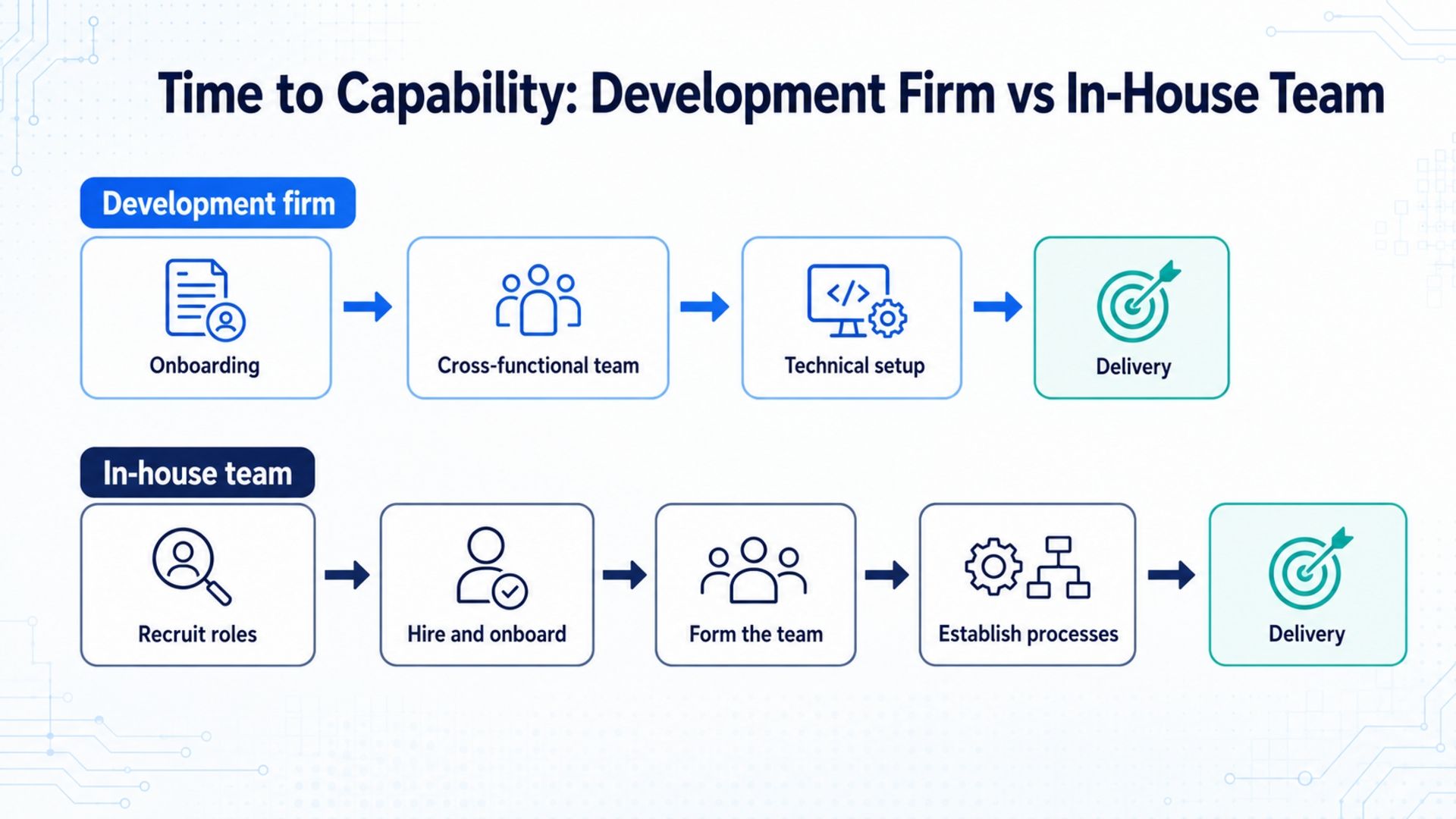
The speed advantage of a development firm often appears before coding begins. A firm may assemble a product-ready team covering frontend, backend, QA, DevOps, architecture, and delivery leadership. An organization building internally must recruit those roles, align their process, and establish the technical environment.
That difference is better described as time to capability: how long it takes to establish a team that can reliably turn a business objective into production software. Starting with one or two developers may feel faster, but missing QA, cloud, security, or product analysis creates later bottlenecks.
A firm is not automatically faster. Delivery will still slow down when requirements are ambiguous, the client has no empowered product owner, stakeholders delay feedback, integrations are poorly documented, or approval processes are unclear. An external team must also learn the company’s domain, users, data, and operating constraints.
For that reason, speed should be measured through delivery performance rather than headcount or lines of code. DORA’s software delivery metrics evaluate both throughput and instability, including change lead time, deployment frequency, failed deployment recovery time, change failure percentage, and deployment rework. These measures help leaders distinguish fast, dependable delivery from activity that creates downstream defects and rework.
A firm is most likely to accelerate delivery when scope priorities are clear, decision-makers are available, reusable engineering practices already exist, and specialist roles can join at the right phase. An in-house team can match or exceed that speed after it becomes mature, especially when members possess deep product knowledge and can make decisions with minimal handoffs.
Risk: Each Model Creates a Different Risk Profile
The choice is not between a risky external model and a safe internal one. Each creates different risks.
Risk area | Development firm exposure | In-house exposure | Practical control |
Knowledge | Important knowledge may remain with the supplier | Knowledge may concentrate around a few employees | Living documentation, cross-training, recorded decisions, and transition rehearsals |
Delivery capacity | Supplier availability or competing commitments may affect delivery | Hiring delays and vacancies can constrain the roadmap | Named team, capacity plan, continuity expectations, and realistic milestones |
Security | External access expands the trust boundary | Internal access can still be excessive or poorly governed | Least-privilege access, environment separation, audit logs, secure development requirements, and access reviews |
Quality | Acceptance may depend too heavily on supplier reporting | Internal teams may lack independent QA or performance expertise | Measurable acceptance criteria, automated tests, release gates, and client visibility |
Commercial | Scope ambiguity can create disputes and change costs | Fixed payroll continues when priorities or budgets change | Clear assumptions, outcome-based milestones, change control, and total-cost review |
Continuity | Vendor dependency can complicate exit or replacement | Attrition can remove critical product knowledge | Client-owned assets, succession planning, knowledge transfer, and an exit plan |
Security responsibilities deserve particular attention. The NIST Secure Software Development Framework recommends integrating secure practices into the software lifecycle and gives acquiring organizations a common language for expressing security expectations to suppliers. In practice, the contract and delivery plan should clarify secure coding, dependency management, access, vulnerability handling, evidence, and remediation ownership rather than simply stating that the application must be secure.
The Hertz–Accenture dispute is a widely cited cautionary case in vendor governance. A 2019 court order recounts Hertz’s allegations that it began a website and mobile application transformation in 2016, hired a technology services firm because it lacked the required expertise, and later sought to recover tens of millions of dollars paid for allegedly deficient services and deliverables. The order addressed a motion to dismiss, so the allegations are not final findings on the merits. The narrower lesson is that brand reputation does not replace precise scope, architecture expectations, acceptance criteria, delivery visibility, and internal governance. The public court record provides the appropriate context.
In-house delivery has its own failure modes. A company may spend months recruiting, depend on a single architect, underinvest in testing, or discover too late that its team lacks experience with scale, security, or enterprise integration. The right decision is the model whose risks the organization can see, fund, and actively control.
Which Delivery Model Fits Your Situation?
Choose a Web Application Development Firm When Capability and Flexibility Matter
A specialized firm is often appropriate when the organization needs to begin within weeks rather than build a department over several quarters. Common situations include launching an MVP within a market window, modernizing an existing application, connecting multiple enterprise systems, addressing a technical capability gap, or increasing delivery capacity for a defined roadmap.
The model is also useful when demand is uneven. Discovery may require business analysis and architecture; implementation may require several developers and QA engineers; launch may require DevOps, performance testing, and security support; maintenance may need a smaller team. A firm can adjust the capability mix without requiring the client to permanently employ every specialist.
Choose an In-House Team When the Application Is a Continuous Core Capability
An internal team is often better when the web application is the company’s central product, its competitive advantage depends on proprietary workflows or algorithms, and the roadmap will remain active for years. Close access to customers, operations, and strategic decisions can help the team learn continuously and preserve institutional knowledge.
This model also makes sense when the organization already has mature engineering leadership, a strong recruitment pipeline, security and platform capabilities, and sufficient long-term work for a complete team. The business must still plan for turnover, specialist gaps, and independent quality assurance. “In-house” is an ownership model, not evidence of engineering maturity by itself.
Choose a Hybrid Model When Product Ownership and Delivery Capacity Need Different Homes
In a hybrid structure, the company retains the product owner, domain experts, architecture authority, and governance roles while a development firm supplies a delivery pod or selected specialties. The external team may build the first release, accelerate a modernization stream, provide QA automation, or operate alongside internal engineers.
This arrangement can provide speed without surrendering strategic control, but it works only when the two teams share a backlog, standards, environments, documentation, and success measures. Knowledge transfer should happen throughout the engagement, not during the final week. The goal is one delivery system with clear responsibilities, not two teams separated by a contract.
Decision Scorecard: Firm, In-House, or Hybrid?
Decision question | Firm | In-house | Hybrid |
Must delivery begin within a few weeks? | Strong fit | Weak initial fit | Strong fit |
Is the application core intellectual property? | Possible with strong controls | Strong fit | Strong fit |
Is the workload stable for several years? | Possible | Strong fit | Strong fit |
Are several specialist skills currently missing? | Strong fit | Weak initial fit | Strong fit |
Will capacity change significantly by phase? | Strong fit | Weak fit | Strong fit |
Does the company have an empowered product owner? | Required | Required | Essential |
Must knowledge ultimately sit inside the company? | Requires a transfer plan | Strong fit | Strong fit if designed deliberately |
Can the company recruit and lead a complete engineering team? | Less critical | Essential | Important for retained roles |
The scorecard should start a leadership discussion, not mechanically calculate the answer. Consider the next 24 to 36 months, not only the first release. A firm is generally strongest when access to capability and flexible delivery matter most. In-house is strongest when continuous product learning and institutional ownership dominate. Hybrid is often appropriate when the company needs both, provided it can govern the combined team.
If your team needs help assessing scope, delivery structure, or technical risk, explore Titan’s Web App Development services before committing to a model.
What to Do After Choosing a Model
Before delivery starts, document the product owner, technical authority, budget owner, repository and cloud ownership, security responsibilities, acceptance process, maintenance model, and transition plan. If a firm is the preferred option, use a structured evaluation rather than comparing portfolios and rates alone. Our guide to nine criteria for choosing scalable custom web app development services provides a detailed vendor checklist. If the model is in-house or hybrid, create a capability map showing which roles already exist, which must be recruited, and which can be supplied temporarily.
Frequently Asked Questions
Is it cheaper to hire a web application development firm or build in-house?
It depends on the time horizon and utilization. A firm can be more economical for defined projects, variable workloads, or temporary specialist needs. An in-house team may become more economical when a stable roadmap keeps a complete team productive for several years. Compare total cost, not salary against hourly rate.
How much control does a business retain when working with a development firm?
The business can retain control of the roadmap, budget, source code, data, cloud accounts, architecture principles, and releases. The agreement and operating model must define those rights explicitly. External engineering delivery does not require giving up product authority.
Should a startup hire a firm or recruit developers internally?
A firm may help a startup reach validation faster when it lacks a complete technical team or needs multiple capabilities immediately. An internal team becomes more important as the product matures and continuous product learning becomes a core advantage. Many startups use a hybrid or transition model rather than treating the choice as permanent.
Can a development firm take over an existing web application?
Yes, but the transition should begin with technical discovery. The firm needs access to the codebase, architecture, environments, dependencies, incident history, backlog, and documentation. A code and infrastructure assessment should identify security, maintainability, performance, and knowledge gaps before new delivery commitments are made.
Can development move from a firm to an in-house team later?
Yes, if transferability is designed from the start. The client should own or control repositories and environments, require current documentation, involve internal staff in reviews, and plan staged knowledge transfer. A transition is much harder when documentation and operational knowledge are postponed until the end.
Conclusion: Choose the Model That Matches the Business
A web application development firm can provide faster access to multidisciplinary expertise and flexible capacity. An in-house team can provide deeper institutional knowledge and continuous ownership of a strategically important product. A hybrid model can combine both advantages when governance and knowledge transfer are explicit.
The right decision depends on total cost, required control, time to capability, product importance, internal maturity, and the risks the organization is prepared to manage. Define those constraints before comparing providers or opening engineering positions. If external or hybrid delivery fits your roadmap, contact Titan Technology to discuss the application, team structure, and delivery priorities.