

Businesses are investing more in custom software because off-the-shelf tools often struggle to support complex workflows, system integrations, and long-term growth. According to Grand View Research, the global custom software development market is projected to reach USD 146.18 billion by 2030. However, this rapid growth also creates a crowded vendor landscape, making it harder for business and technology leaders to identify a partner that can support more than short-term delivery.
Building a custom web application is not just about launching features. A web app may work well in its early stages, but as user volume, data, integrations, and business processes scale, weak architecture can lead to performance bottlenecks, security vulnerabilities, costly maintenance, and future rebuilds.
That is why choosing the right custom web app development services partner matters from the beginning. This guide breaks down nine practical criteria to help businesses evaluate whether a technology partner can support scalable architecture, security, QA, integration, delivery transparency, and long-term product growth.
What Are Custom Web App Development Services?
Custom web app development services refer to the end-to-end planning, design, development, testing, deployment, and maintenance of web-based software tailored to a company’s specific business needs. Unlike standard off-the-shelf platforms, a custom web application is designed to align with how an organization operates, how users interact with digital systems, and how data flows across departments, tools, and workflows.
A comprehensive service should cover both the user-facing experience and the core engineering layers:
Experience Design: UI/UX design, prototyping, and user journey mapping.
Core Engineering: Frontend development, backend development, database architecture, and application logic.
Ecosystem Connectivity: API development and integrations with internal and third-party systems such as CRM, ERP, payment platforms, reporting tools, and legacy software.
Lifecycle Management: Cloud deployment, QA and testing, test automation where appropriate, performance optimization, monitoring, and maintenance.
For business and technology leaders, the value of custom web app development goes beyond building unique features. It comes from creating a centralized digital environment that improves operational efficiency, increases data visibility, supports secure access control, and enables long-term scalability.
This is especially important for companies with complex workflows, industry-specific requirements, or growth plans that standard software cannot fully support. When designed properly, a custom web application becomes a core business system that can evolve with the organization over time.
When Does Your Business Need Custom Web App Development Services?
Not every business problem requires a custom web application. In many cases, standard SaaS platforms are enough to manage basic workflows, reporting, communication, or customer interactions. However, custom web app development services become more relevant when existing tools start limiting how the business operates, scales, or serves its users.
A business should strongly consider custom web app development when it encounters these critical signs:
Outgrown off-the-shelf software: Workflows are too specific, and standard tools force the business to adapt around software limitations.
Heavy reliance on manual workarounds: Spreadsheet-based approvals may work for a small team, but they become bottlenecks as departments, customers, partners, or compliance requirements increase.
Scattered data silos: Data is fragmented across disconnected systems, making real-time reporting and a single source of truth difficult to achieve.
Complex integration needs: The business requires deeper integration with CRM, ERP, payment gateways, logistics platforms, or internal databases.
Advanced security and access requirements: The system needs secure role-based access, audit trails, customer or partner portals, or stricter control over sensitive data.
In these situations, the challenge is not only building a new interface. The real challenge is connecting business logic, data flow, security, and operational control into one scalable system.
For example, a logistics company may begin with manual shipment tracking and email-based coordination. As order volume grows, that approach can lead to delayed updates, duplicated data entry, and poor customer visibility. A custom web application can centralize shipment status, internal operations, customer access, and reporting dashboards in one platform.
The decision should be driven by business complexity, scalability needs, integration requirements, and long-term product value. If standard tools are forcing the business to work around software limitations, it may be time to evaluate a custom solution.
The 9 Criteria for Choosing a Scalable Custom Web App Development Partner
Choosing a custom web app development partner should not be based only on portfolio design, hourly rates, or technology stack. For business-critical systems, the real evaluation should focus on whether the partner can design, build, test, and support a web application that remains stable as usage, data, integrations, and business requirements grow.
A scalable partner should be able to connect business understanding with engineering discipline. They should know how to translate requirements into architecture, manage technical trade-offs, protect sensitive data, ensure software quality, and support the product after launch. The following nine criteria can help business and technology leaders evaluate vendors more effectively before making a development decision.
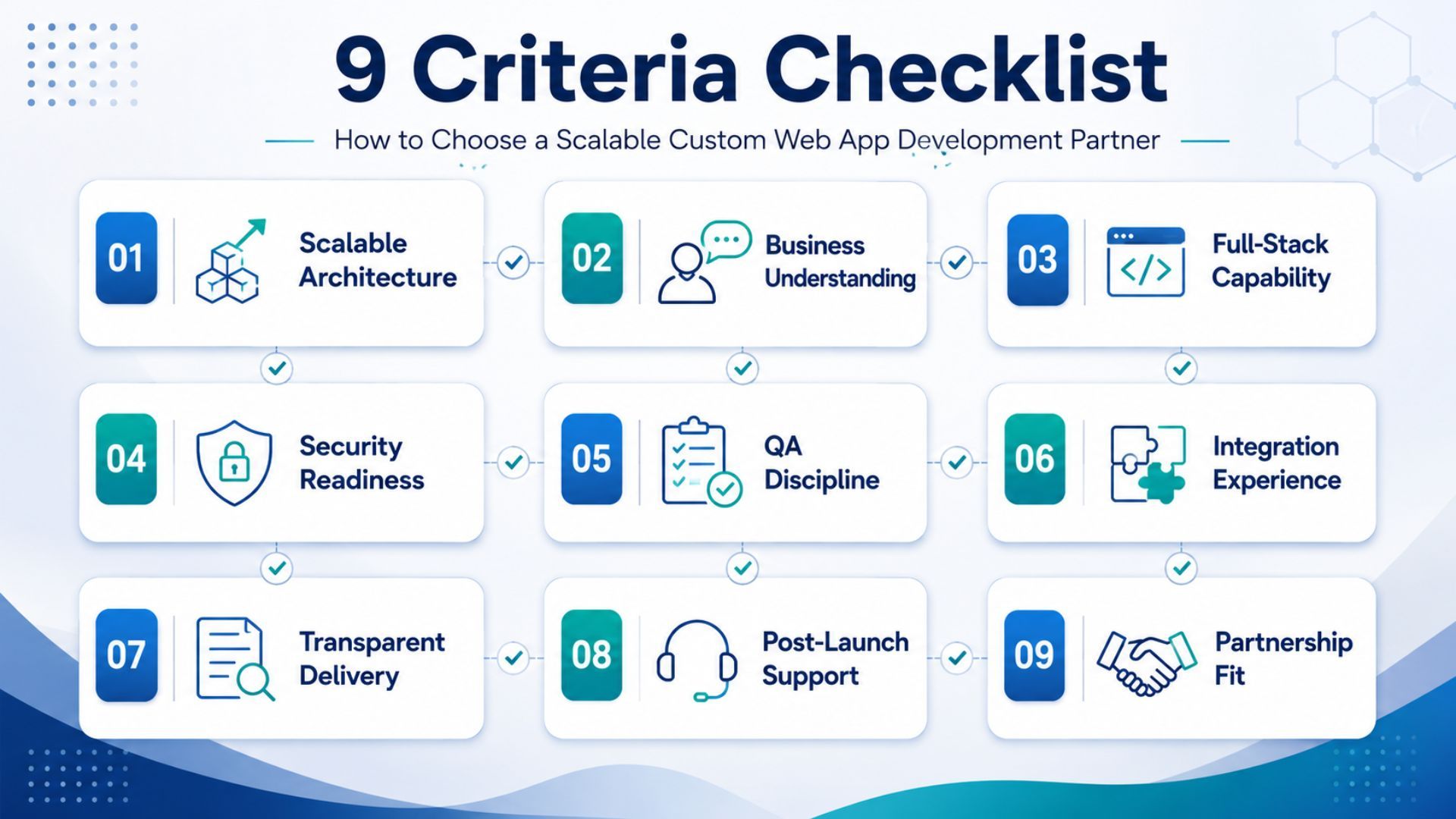
1. Scalable Architecture Thinking
Scalability starts before the first line of code is written. A reliable development partner should explain how the application architecture will support future users, data volume, feature expansion, and system integrations.
This does not always mean choosing the most complex architecture from day one. A modular monolithic architecture may be more practical for an early-stage product, while a service-based architecture may be necessary for multiple user groups, higher transaction volume, or enterprise integrations.
The key question is whether the partner can design with growth in mind while balancing delivery speed, budget, and maintainability. A scalable partner should discuss database structure, API design, cloud readiness, performance risks, and technical debt in clear business terms.
Questions to ask your vendor:
How do you evaluate scalability requirements before development starts?
How do you prevent early architecture decisions from limiting future growth?
How do you plan for performance testing as usage, data, and integrations increase?
2. Business Understanding Before Technology Recommendation
A strong custom web app development partner should not recommend a framework, cloud platform, or architecture pattern before understanding the business problem. Technology choices should be driven by operational goals, user needs, data flow, security requirements, and long-term product direction.
This matters because custom web applications often reflect how the business actually operates. A finance reporting portal, for example, may need approval workflows, permission control, audit trails, accounting integrations, and secure access for different user roles.
A professional partner should start with discovery, process mapping, user journey review, and requirement prioritization. They should clarify what needs to be built now, what can wait, and which requirements may create unnecessary complexity.
Questions to ask your vendor:
How do you validate business requirements before recommending a technical solution?
How do you identify essential first-release features versus future enhancements?
How do you handle unclear, changing, or conflicting requirements during the project?
3. Full-Stack Technical Capability
Custom web app development requires more than frontend implementation. A scalable system depends on the quality of the entire technical stack, including the user interface, backend logic, database design, APIs, infrastructure, deployment process, and monitoring setup.
A capable partner should support both user-facing experience and core engineering. This includes responsive interfaces, reliable backend services, performance-aware databases, secure APIs, cloud deployment, and maintenance after release.
This capability becomes more important when the application needs to connect with CRM, ERP, payment gateways, logistics platforms, analytics tools, or internal databases. Weakness in one layer can create delivery gaps, integration delays, or maintenance issues.
Questions to ask your vendor:
What frontend, backend, database, and cloud technologies does your team use for scalable web applications?
How do you manage code quality, documentation, and technical consistency across the team?
Can your team support new development and future modernization as the product evolves?
4. Security and Compliance Readiness
Security should be considered from the beginning, not treated as a final-stage technical check. A scalable web application often handles business data, customer information, user permissions, internal workflows, and third-party integrations. If security is not built into the architecture and development process, the business may face data exposure, unauthorized access, compliance risks, and higher remediation costs after launch.
A reliable partner should explain how security is handled across the development lifecycle. This includes secure coding practices aligned with OWASP guidelines, authentication, authorization, role-based access control, encryption, API security, logging, vulnerability management, and release reviews.
Compliance readiness is also important for finance, healthcare, logistics, SaaS, and enterprise services. Even when strict compliance is not required from day one, the application should still be designed with data protection, auditability, and access control in mind.
Questions to ask your vendor:
How do you include security considerations during architecture and development?
How do you align secure coding and testing practices with OWASP guidelines?
How do you manage authentication, authorization, role-based access, and sensitive data protection?
5. QA and Testing Discipline
A custom web application should not only work under ideal conditions. It must remain reliable when users perform unexpected actions, data volume increases, integrations fail, or new features are added over time. That is why QA and testing discipline are essential when evaluating custom web app development services.
A strong partner should have a testing process that covers functional testing, regression testing, API testing, cross-browser testing, performance testing, and user acceptance testing. Test automation should be used where it adds value, especially for stable workflows, repeated releases, and long-term product maintenance.
QA is not only about finding bugs before launch. It reduces business risk, protects user experience, and helps ensure that future updates do not break critical workflows.
Questions to ask your vendor:
What types of testing are included before each release?
How do you decide which test cases should be automated?
How do you manage regression risk when features, integrations, or user roles are added?
6. Integration Experience With Business Systems
Most scalable web applications do not operate in isolation. They need to connect with CRM, ERP, payment gateways, identity providers, analytics platforms, logistics systems, reporting tools, or internal databases. Integration quality can directly affect operational efficiency, data accuracy, and user experience.
A capable partner should understand how to design, build, secure, and maintain integrations across different systems. This includes API design, data mapping, error handling, synchronization logic, access control, documentation, and monitoring. Poorly planned integrations can create duplicate data, manual rework, reporting delays, and operational blind spots.
Integration experience is especially important when the web app is expected to become part of a broader digital ecosystem. The application should not become another disconnected tool. It should help unify workflows, improve data visibility, and support better decision-making.
Questions to ask your vendor:
What types of third-party or enterprise system integrations have you handled before?
How do you manage API reliability, error handling, and data synchronization?
How do you document integrations so they can be maintained and extended?
7. Transparent Delivery Process
A scalable custom web application requires a delivery process that keeps scope, timeline, risks, and decisions visible throughout the project. Without transparency, stakeholders may only discover issues when delays, budget changes, or quality problems are already difficult to control.
A reliable partner should have a clear process for planning, sprint execution, progress reporting, risk management, and change request handling. This is especially important when business teams, product owners, IT departments, compliance teams, and external vendors are involved.
Regular demos, clear documentation, milestone tracking, and open communication help decision-makers review progress early and adjust priorities when needed.
Questions to ask your vendor:
How do you keep stakeholders informed about progress, risks, and delivery status?
How often will we see working demos or review completed features?
How do you manage scope changes, technical risks, and project dependencies?
8. Post-Launch Support and Product Evolution
A custom web application is not finished when the first version goes live. After launch, the system needs monitoring, bug fixing, performance optimization, security updates, user feedback review, and continuous improvement. This is where the difference between a short-term vendor and a long-term technology partner becomes clear.
A strong partner should provide a clear post-launch support model. This may include maintenance planning, incident response, performance monitoring, cloud cost optimization, feature enhancement, technical support for future releases, and Service Level Agreement (SLA) expectations for production issues.
Post-launch support is especially important for customer portals, internal operation platforms, SaaS products, logistics dashboards, financial systems, and enterprise workflow tools that must remain reliable after release.
Questions to ask your vendor:
What support and maintenance services are available after launch?
Do you provide SLA expectations for response time, incident priority, and issue resolution?
How do you monitor application performance, stability, and production issues?
How do you support future feature development as business requirements evolve?
9. Long-Term Partnership Fit
The right custom web app development services partner should support more than one project phase. Scalable systems often evolve over months or years as the business adds users, features, integrations, markets, data sources, and automation requirements.
Long-term partnership fit depends on team stability, communication quality, knowledge retention, documentation practices, IP protection, and the ability to scale resources when needed. It also depends on whether the partner understands the business context well enough to provide practical recommendations.
The goal is not only to deliver the first release. The goal is to choose a partner that can help the platform remain secure, scalable, maintainable, and aligned with future business priorities.
Questions to ask your vendor:
How do you retain project knowledge and documentation over time?
Can your team scale up or down based on roadmap and delivery needs?
How do you protect intellectual property, source code, and business-sensitive information?
Vendor Selection Checklist for Scalable Web App Development
Choosing a custom web app development partner is easier when the evaluation process is structured. Instead of comparing vendors only by price, portfolio, or promised delivery speed, business and technology leaders should look at whether each provider can support the full lifecycle of a scalable system.
Use the checklist below to assess whether a vendor is prepared to design, build, secure, test, integrate, and maintain a custom web application that can grow with your business.
Selection Criteria | What to Check | Why It Matters |
Scalable architecture | Modular design, cloud readiness, database planning, API strategy | Helps prevent costly rebuilds as users, data, and features grow |
Business understanding | Discovery process, workflow mapping, requirement prioritization | Ensures the application solves real business problems |
Full-stack capability | Frontend, backend, database, cloud, DevOps, monitoring | Reduces delivery gaps across the product lifecycle |
Security readiness | OWASP-aligned practices, access control, encryption, audit logs | Protects sensitive data and lowers security risk |
QA discipline | Functional, regression, API, performance, and automation testing | Improves release quality and reduces production issues |
Integration experience | CRM, ERP, payment systems, internal databases, third-party APIs | Connects the app with real business operations |
Delivery transparency | Sprint reviews, documentation, risk reporting, change control | Keeps stakeholders aligned and reduces uncertainty |
Post-launch support | Maintenance, monitoring, SLA expectations, future enhancements | Keeps the application stable after release |
Partnership fit | Team stability, knowledge retention, IP protection, flexible scaling | Supports long-term product growth |
A strong vendor does not need to be perfect in every area from the first conversation. However, they should be able to explain their approach clearly, provide relevant examples, and show how they manage trade-offs between speed, scalability, security, and cost.
This checklist can also be used during proposal review, vendor interviews, or internal procurement discussions. If a provider cannot give clear answers on architecture, QA, security, integration, and post-launch support, that is usually a sign that the partnership may create more risk as the product grows.
Engagement Model Fit: Choose Based on Product Stage
The right engagement model can shape how efficiently a custom web app development project moves from planning to launch and long-term improvement. The best fit depends on how clear the requirements are, how fast the product needs to evolve, and how much flexibility the business needs during development.
Fixed-Cost Model: Best suited for well-defined projects with stable requirements, where the business needs stronger budget control and delivery predictability.
Time & Material (T&M) Model: Better suited for evolving products, where priorities may change as user feedback, market needs, or technical requirements become clearer.
Dedicated Team Model: Suitable for long-term platform development, where the business needs continuity, retained product knowledge, and the ability to scale development capacity over time.
The key is not to choose the cheapest model, but to choose the model that matches the product stage and delivery risk. A good development partner should explain which engagement model fits your roadmap, where trade-offs may appear, and how the model can support both the first release and future growth.
For a deeper breakdown of outsourcing models, benefits, and risks, read our guide on how to turn app outsourcing into a long-term growth engine.
Common Red Flags When Comparing Custom Web App Development Services
A strong custom web app development partner should make risks, trade-offs, and technical decisions clear from the beginning. If a vendor only focuses on speed, price, or visual design without discussing architecture, security, QA, and long-term support, the project may look efficient at first but become difficult to scale later.
Here are several red flags business and technology leaders should watch for during vendor evaluation:
Technology is recommended too early: If a vendor suggests a framework, cloud platform, or architecture before understanding workflows, users, data, and business goals, the solution may be driven by convenience rather than fit.
The proposal focuses only on features: A feature list is not enough for a scalable web application. The vendor should also explain architecture, performance planning, integration approach, security practices, and maintenance strategy.
QA and security are treated as final steps: Testing and security should be built into the development process, not added only before launch. If these areas are unclear in the proposal, production risk may increase.
Integration complexity is underestimated: Many custom web apps need to connect with CRM, ERP, payment systems, reporting tools, internal databases, or third-party APIs. If the vendor cannot explain integration risks and data flow clearly, the project may face delays later.
Communication and ownership are vague: Unclear roles, irregular updates, weak documentation, and no structured review process can create misalignment between business stakeholders and the development team.
There is no post-launch support plan: A web application needs maintenance, monitoring, performance optimization, and future enhancements after release. If a vendor only focuses on launch, the business may struggle to manage the system as it grows.
A lower-cost proposal is not always a bad choice, and a fast delivery timeline is not always unrealistic. The real concern is when a vendor cannot explain the trade-offs behind cost, speed, architecture, quality, and long-term maintainability.
When comparing custom web app development services, the safest partner is usually the one that asks thoughtful questions, surfaces risks early, and helps the business make informed technical decisions before development begins.
How Titan Supports Scalable Custom Web App Development
Choosing the right partner is not only about finding a team that can write code. For scalable web applications, businesses need a partner that can understand the product vision, translate requirements into practical architecture, manage engineering quality, and support the system after launch.
Founded in March 2013, Titan has grown into a software outsourcing company with 300+ resources and development centers in Vietnam. Our core software services include full-cycle development, maintenance and support, monitoring and support, and testing and automation. These capabilities help businesses plan, build, test, deploy, and improve custom web applications over time.
For companies building customer portals, workflow systems, SaaS products, reporting dashboards, or enterprise integration platforms, our Web App Development service supports the full application lifecycle. Scalable delivery is also strengthened by our Quality Assurance & Testing, Data Engineering, and Digital Transformation capabilities.
Relevant project examples include:
- SaaS CRM automation and cloud modernization: Titan supported a SaaS CRM platform with workflow automation, device synchronization, feature enhancement, testing, ongoing maintenance, and AWS-based cloud infrastructure.
- ERP and business system development: In Titan’s Dot NET case study, the TTTM ERP system supported business functions such as HR, finance and accounting, sales, CRM, inventory, price management, and data synchronization across headquarters and branches.
- DevOps and workflow platform support: In a DevOps case for a large professional services organization, Titan supported infrastructure migration, pipeline automation, security requirements, BCP/DR planning, logging, and monitoring.
Our delivery approach is supported by Agile methodologies, CMMI Level 3 best practices, and security practices aligned with ISO 27001:2022 standards. The goal is not only to launch the first version of a web application. It is to help businesses build scalable, secure, and maintainable systems that can evolve with users, data, integrations, and future digital initiatives.
Conclusion: Choose a Partner Who Can Support Long-Term Scalability
Selecting custom web app development services is not only about building the first version of a product. It is about choosing a partner that can support scalable architecture, security, QA, integration, delivery transparency, and long-term product evolution.
The right partner should help your business clarify requirements, manage technical trade-offs, and build a system that remains maintainable as users, data, workflows, and integrations grow. A lower-cost or faster proposal may look attractive at first, but the stronger choice is usually the team that can explain risks clearly and support the product beyond launch.
If your business is planning to build a scalable custom web application, use the nine criteria in this guide to compare vendors more objectively.
Ready to evaluate your web app roadmap? Contact our team to discuss your architecture, integration, QA, and scalability priorities.