

As organizations grow, enterprise resource planning (ERP), customer relationship management (CRM), and departmental applications often evolve independently. Employees may need to move between systems to complete a single workflow, while IT teams must maintain integrations, reconcile inconsistent records, and protect sensitive information. Enterprise web application development can address these challenges, but building a unified interface is only one part of the work.
The harder decisions concern architecture, data ownership, security, resilience, and how to modernize without interrupting essential operations. This guide examines five engineering practices and a practical planning framework for organizations developing or upgrading complex enterprise applications.
What Makes Enterprise Web Applications Complex?
Enterprise applications support interdependent processes rather than isolated user journeys. A sales request may trigger inventory checks, credit approval, invoicing, and reporting across multiple teams. Each step can have different permissions, business rules, and audit requirements. Meanwhile, existing ERP, CRM, legacy databases, and external services may have incompatible data models or release schedules.
Non-functional requirements add another layer: applications may need predictable response times, recoverable failures, access controls, and maintainability across years of organizational change. Consider a hypothetical company building one web portal for sales, finance, and administrators while retaining its existing ERP and CRM. We will use this illustrative scenario—not a reported client project—to examine the technical decisions that follow.
Five Best Practices for Enterprise Web Application Development
1. Choose the Right Architecture for Enterprise Web Application Development
Start with business capabilities and their dependencies, not a preferred technology trend. Identify bounded domains—such as orders, customer accounts, and billing—and decide which must evolve or scale independently. A modular monolith can enforce clear internal boundaries while keeping deployment and transactional consistency relatively straightforward. Microservices can enable independent deployments and team ownership, but add network failure modes, distributed data management, and operational overhead. Domain-driven design can help teams define boundaries in either approach.
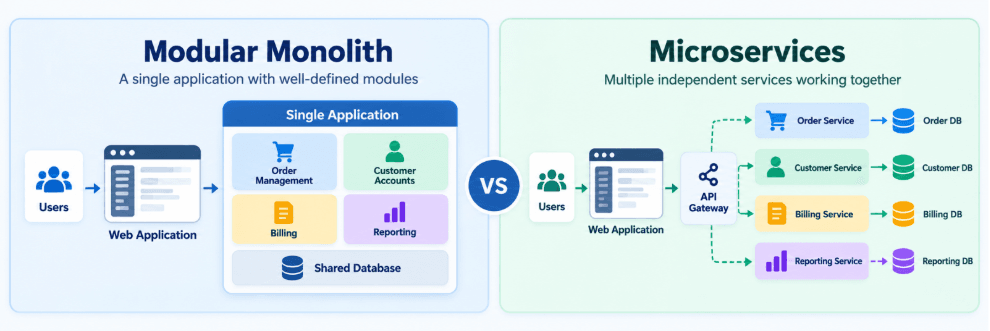
Real-world example — Shopify: In its engineering account of deconstructing its Rails monolith, Shopify explains that it chose a modular monolith rather than treating microservices as a universal answer. It reorganized code around business concepts and component boundaries to manage growing complexity. This illustrates an architecture decision, not a claim that Shopify operates a typical internal enterprise portal.
2. Design Reliable Enterprise System Integration and Data Architecture
Map every critical data flow before implementing integrations. Establish which system is authoritative for each record, define API contracts, and document failure and retry behavior. An integration layer can isolate the new application from inconsistent legacy interfaces; asynchronous events are useful where workflows do not require an immediate response. However, event-driven designs also need idempotency, monitoring, and reconciliation when messages arrive late or more than once.
In the hypothetical ERP/CRM portal, the CRM might own customer profiles while the ERP owns order status and invoices. The portal should reference those authoritative sources rather than silently creating competing master records. If historical data must move, profile its quality, map identifiers, test migration in stages, and define reconciliation and rollback procedures. Design user workflows for pending or temporarily unavailable information, rather than assuming all integrations will always respond.
Enterprise integration remains fragmented even as API-led architectures gain adoption. In CIO&LEADER's State of Enterprise Technology 2025 survey, 35.7% of surveyed CIOs reported using a mixed integration approach that combined legacy tools, APIs, iPaaS, and ad hoc methods, while 28.6% used APIs managed through an API gateway. The findings reinforce why enterprise web applications need explicit integration boundaries and governance rather than relying on point-to-point connections as systems grow
A SaaS CRM modernization project illustrates how integration challenges can emerge as an enterprise platform evolves. The platform needed to expand beyond basic contact management while addressing legacy maintenance constraints and device synchronization. The project involved workflow automation, device synchronization, feature enhancements, testing, ongoing maintenance, and AWS-based cloud infrastructure. It demonstrates why enterprise modernization often requires application integration, data flows, and infrastructure to evolve together rather than isolated initiatives.
3. Embed Enterprise Web Application Security and Governance from the Start
Security requirements should shape architecture and workflows from discovery onward. Use threat modeling to identify sensitive assets, trust boundaries, and abuse cases. Enforce authentication and authorization on the server, apply least privilege, protect secrets, encrypt sensitive data where appropriate, and retain audit trails for high-risk actions. Role-based access control is useful, but some workflows also require record-level or attribute-based restrictions.
For the ERP/CRM example, sales representatives might view only assigned accounts, finance teams might approve invoices, and administrators might manage access without automatically seeing all business data. Verify these rules through automated authorization tests, including attempts to access another team's records. OWASP's Application Security Verification Standard provides a practical verification reference; NIST's Secure Software Development Framework offers broader guidance for integrating security into development processes.
4. Engineer Scalable Enterprise Web Applications for Performance and Resilience
Define measurable service objectives before choosing scaling technologies. Identify the transactions that matter most, establish response-time and availability targets, and test with realistic data volumes and concurrent users. Query optimization, indexing, caching, and selective horizontal scaling should follow measured bottlenecks—not assumptions that every application needs a highly distributed architecture.
Resilience also requires explicit failure behavior. If the ERP is temporarily unavailable, the portal could show the latest clearly labeled status, queue eligible noncritical actions, or prevent transactions that require immediate confirmation. Queuing is not suitable for every operation: financial approvals, for example, may need synchronous validation. Add timeouts, bounded retries, alerts, and recovery procedures. Monitor user-facing outcomes, not just server uptime, so degraded workflows are visible before they become widespread.
5. Establish Automated Testing, Observability, and Continuous Delivery
A maintainable delivery pipeline tests the boundaries most likely to fail. Combine unit tests for business rules, integration and contract tests for ERP/CRM interfaces, end-to-end tests for critical user journeys, and security and performance checks appropriate to risk. Automated pipelines should support staged releases and documented rollback, while ownership and architecture reviews help prevent technical debt from accumulating across teams.
Use logs, metrics, and traces to investigate failures across the portal and its integrations. DORA's software delivery metrics, including deployment frequency and change failure rate, can help assess delivery throughput and instability over time; they should be interpreted within the context of the specific application rather than treated as universal targets.
How to Plan an Enterprise Web Application Development Project
Assess Existing Systems and Define Project Requirements
Begin with a focused discovery phase: inventory applications, interfaces, data ownership, dependencies, security obligations, and current operational pain points. Interview both business users and the teams maintaining legacy systems. Document critical workflows and accessibility needs for people with different roles, then prioritize requirements by business impact and technical risk. Establish baselines such as P95 response time, workflow completion time, integration error rate, and incident recovery time; targets should reflect actual business requirements.
In the ERP/CRM scenario, the first decision is not which frontend framework to use. It is whether the portal can safely read customer and order records, who may update them, and which actions must continue if one backend is unavailable.
A multi-site ERP development project demonstrates why data topology should be considered early in the discovery process. The system supports HR, finance and accounting, sales, CRM, inventory, price management, and data synchronization across headquarters and branch locations. This example highlights an important architectural question for enterprise teams: which data must be immediately available at each location, and which data can be synchronized asynchronously across the organization?
Choose Between Integration, Incremental Modernization, and Full Replacement
Three delivery approaches address different starting conditions. A new application with integration is appropriate when existing systems still perform core functions reliably. Incremental modernization replaces selected capabilities while legacy and new components coexist. Full replacement may be justified when an existing system cannot meet essential requirements, but migration, training, and cutover risks require careful planning.
Approach | Consider when | Main risk to manage |
New application with integration | Core ERP/CRM remains fit for purpose | Interface dependencies and data ownership |
Incremental modernization | Selected legacy capabilities need replacement | Temporary coexistence and data reconciliation |
Full replacement | Existing system no longer supports critical needs | Migration accuracy, adoption, and cutover |
The Strangler Fig approach offers a useful model for incremental modernization: route a selected capability to a new implementation, validate it in production, and progressively retire from the old path. Martin Fowler describes this as an alternative to a single high-risk cutover, while emphasizing that modernization still requires changes to delivery practices and organizational responsibilities.
Applied to our hypothetical portal, an organization could initially expose existing ERP and CRM functions through controlled interfaces. It might later replace an outdated order-management module while retaining finance and customer systems. Each transition should include parallel-run checks where needed, reconciliation, user acceptance testing, a cutover decision, and a fallback plan. The best approach depends on business continuity requirements, data quality, dependencies, and the organization's capacity to operate a temporary hybrid environment.
Evaluate Development Partners and Delivery Capabilities
Ask potential partners to demonstrate experience with comparable integration and modernization challenges—not simply a list of frameworks. Review their proposed architecture, security practices, QA strategy, migration approach, documentation, and post-launch ownership. A useful discovery deliverable is a dependency map, a prioritized risk register, a phased delivery plan, and explicit acceptance criteria. Confirm how external engineers will collaborate with internal IT and who will maintain integrations after launch.
Organizations exploring delivery support can review our custom web application development services.
How Much Does Enterprise Web Application Development Cost?
Costs depend on business scope, integrations, data migration, security requirements, user experience complexity, testing, and ongoing support. For example, connecting a portal to older ERP and CRM systems may require undocumented-interface discovery, data cleansing, middleware, and additional regression testing. Estimate these activities separately from new feature development and evaluate total cost of ownership rather than comparing initial build quotes alone. A discovery phase is usually necessary before producing a defensible project-specific estimate.
How Long Does It Take to Develop an Enterprise Web Application?
There is no reliable universal timeline. Delivery depends on the number of workflows, interface readiness, data quality, approval cycles, and whether the legacy environment must remain operational. In our ERP/CRM scenario, an initial portal for one department may be delivered before more complex cross-department workflows. Phased delivery can expose integration problems earlier and provide usable capabilities sooner, but temporary coexistence can also increase coordination effort. Set milestones after validating dependencies, not from a generic estimate.
Should Enterprises Build Custom Applications or Use Off-the-Shelf Software?
Off-the-shelf software may suit standardized workflows when configuration and available integrations meet requirements. Custom development may be justified by distinctive business processes, unusual data models, or the need for tighter control over integration and user experience. A hybrid approach is also possible: retain ERP and CRM products while building a tailored portal around them. Compare functional fit, vendor constraints, security, integration effort, long-term maintenance, and total cost before deciding; custom software is not automatically the better option.
Building Enterprise Web Applications for Long-Term Growth
Successful enterprise web application development starts with business boundaries and existing system constraints. Architecture should fit team and workflow complexity; integration needs clear data ownership; security and resilience must be designed in; and testing should cover the workflows users depend on. The delivery strategy—integrate, modernize incrementally, or replace—should follow an explicit assessment of risk, cost, and continuity rather than technology fashion.
Explore Titan Technology Corporation’s web app development solutions, or contact our team to discuss your operational requirements.