

An AI pilot can prove that a model works under controlled conditions. It cannot prove that the surrounding system is ready to serve real users, connect with live enterprise data, meet security requirements and operate reliably at scale.
The real challenge begins when AI moves into production. Models must work within existing workflows, respect user permissions, handle changing data, integrate with business systems and maintain acceptable quality, latency and cost.
This implementation-focused guide provides a strategic framework for business and technology leaders moving an AI pilot into controlled production. It is not a vendor comparison or a detailed engineering runbook. The final architecture, evaluation thresholds and delivery timeline will depend on the use case, data environment, risk level and industry.
Organizations still evaluating their technology foundation should first review how to choose the right AI platform for their business.

From AI Pilot to Enterprise AI Platform: What Actually Changes?
A pilot is designed to answer a narrow question: can AI improve a specific task or workflow?
An enterprise AI platform must answer a broader one: can the organization operate, govern and continuously improve AI-enabled workflows across users, systems and business units?
Dimension | AI pilot | Enterprise AI platform |
Scope | One use case | Multiple workflows or business units |
Users | Small test group | Employees, customers or partners at scale |
Data | Curated or limited dataset | Continuously changing production data |
Integration | Demo or manual connection | ERP, CRM, APIs and internal systems |
Reliability | Temporary interruption may be acceptable | Availability, fallback and recovery are required |
Governance | Project-level review | Enterprise permissions, policies and audit trails |
Cost | Pilot budget | Unit economics and ongoing cost control |
Ownership | Innovation or technical team | Shared business, engineering, security and risk ownership |
Four transitions define the move to production:
- Model accuracy becomes end-to-end service quality.
- Isolated datasets become governed data pipelines.
- Project delivery becomes lifecycle operations.
- Individual experimentation becomes enterprise ownership.
The platform must therefore be designed around the complete business service, not only the model behind it.
Why Many Enterprise AI Pilots Do Not Reach Measurable Scale
The pilot-to-production gap is not theoretical.
The Project NANDA report, The GenAI Divide: State of AI in Business 2025, examined more than 300 publicly disclosed AI initiatives, conducted structured interviews with representatives from 52 organizations and surveyed 153 senior leaders.
In its sample, only 5% of embedded or task-specific enterprise GenAI tools were successfully implemented. Success was defined as moving beyond the pilot stage with measurable KPIs and, for task-specific tools, marked and sustained productivity and/or profit-and-loss impact. The report linked stalled implementations to brittle workflows, a lack of contextual learning and misalignment with day-to-day operations.
The figure should not be interpreted as a universal claim that 95% of all AI projects fail. The researchers explicitly state that:
- The sample may not represent every enterprise segment or geographic region.
- Selection bias may have affected which organizations participated.
- Success metrics differed across organizations and industries.
- The six-month observation window may understate success for complex, long-term enterprise deployments.
These limitations make the result a warning signal rather than a universal failure rate.
The practical lesson is that model capability alone is insufficient. Initiatives commonly stall when they lack workflow fit, production ownership, dependable data, user adoption and measurable business outcomes.
Phase 1: Turn Pilot Results into Production Acceptance Criteria
The first implementation decision should not be, “How quickly can we launch?”
It should be, “What evidence must exist before this system is allowed into production?”
A practical production gate should cover three areas.
Business acceptance
Confirm that the pilot produced a repeatable improvement in a defined metric, such as:
- Time saved per completed task
- Reduction in processing cost
- Higher completion or resolution rate
- Improved forecast accuracy
- Reduced human correction
- Increased conversion or revenue
The workflow owner should also confirm that the solution fits the real operating process. Accurate output does not create value if it introduces excessive review or transfers work to another team.
Technical acceptance
Evaluate the complete service:
- Output quality and consistency
- P95 response latency
- Throughput under expected demand
- Integration stability
- Availability and recovery
- Permission enforcement
- Performance with representative production data
For generative AI, additional measures may include groundedness, retrieval success, hallucination rate, tool-use accuracy and human-escalation rate.
Risk and ownership acceptance
Document what data the system may access, which decisions require human approval, who owns incidents and what conditions trigger rollback or suspension.
The following release gate can be adapted to each use case:
Gate | Example approval condition |
Business value | Target workflow KPI achieved consistently |
Output quality | Agreed quality threshold met on representative evaluations |
Security | No unresolved critical data-leakage or access-control issue |
Performance | P95 latency remains within the service requirement |
Human oversight | Escalation and approval paths work as designed |
Cost | Cost per completed workflow remains within the business case |
Recovery | Fallback and rollback have been tested |
Ownership | Business, technical and support owners are assigned |
Case in practice: According to the OpenAI case study on ENEOS Materials, 80% of employees reported significant workflow improvements during the pilot. The company later expanded access across the organization, reaching more than 90% weekly usage and creating over 1,000 custom GPTs. The case illustrates how pilot evidence, secure access and cross-functional participation can support a broader rollout decision.
Phase 2: Design a Modular Enterprise AI Platform Architecture
A scalable platform should not be built as one large application tied directly to one model provider.
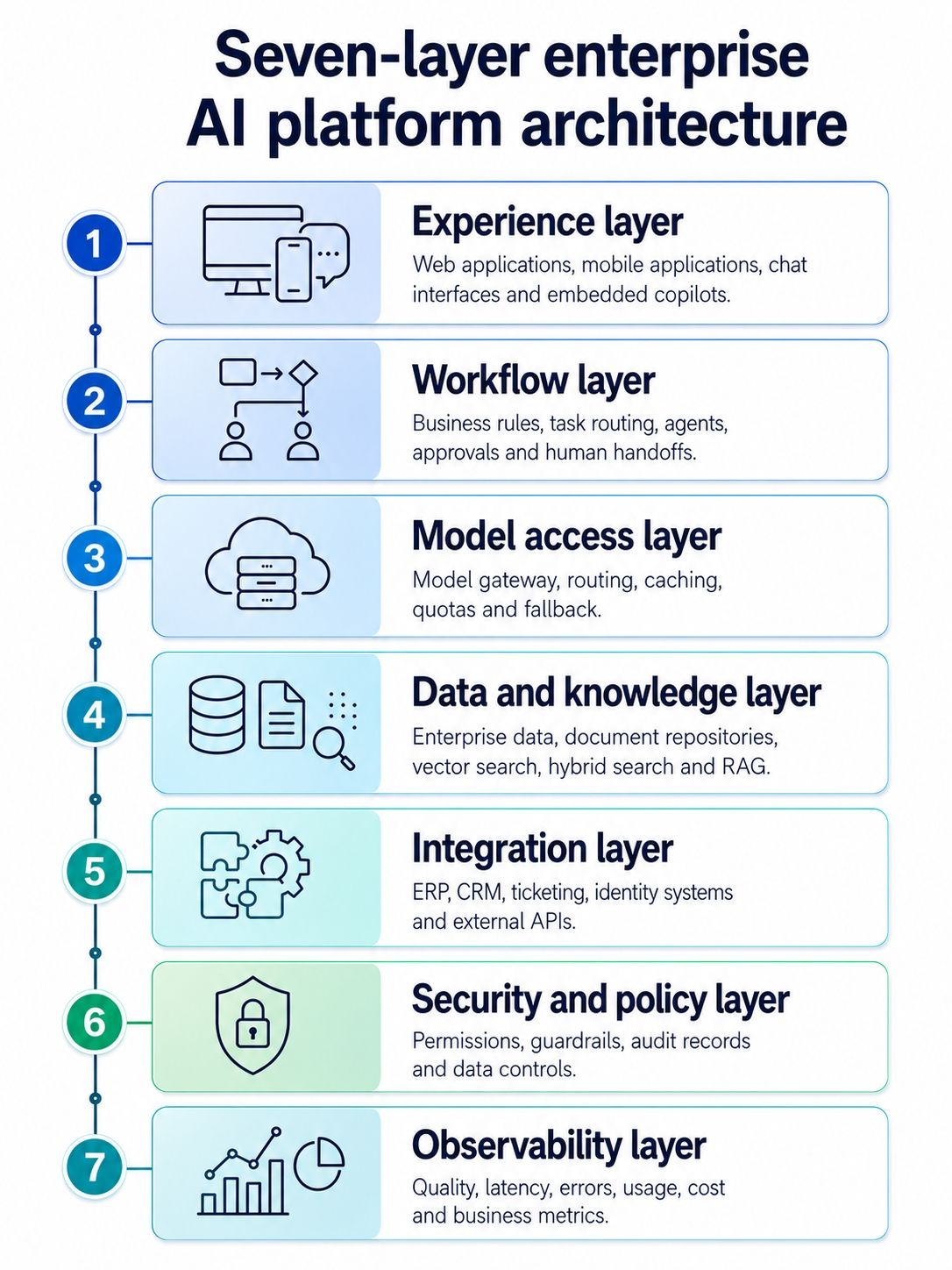
A practical architecture normally includes:
Experience layer: Web applications, mobile applications, chat interfaces and embedded copilots.
Workflow layer: Business rules, task routing, agents, approvals and human handoffs.
Model access layer: Model gateway, routing, caching, quotas and fallback.
Data and knowledge layer: Enterprise data, document repositories, vector search, hybrid search and RAG.
Integration layer: ERP, CRM, ticketing, identity systems and external APIs.
Security and policy layer: Permissions, guardrails, audit records and data controls.
Observability layer: Quality, latency, errors, usage, cost and business metrics.
Separate models from business logic
Business rules should not be hard-coded into one provider-specific integration.
A model gateway gives applications a stable internal endpoint while allowing requests to be routed according to quality, cost, latency, availability or data requirements. It also makes fallback and provider changes less disruptive.
Microsoft’s multi-backend AI gateway architecture describes how centralized routing, quotas and policies can be applied across multiple model deployments.
Organizations that have not finalized the model-serving layer can also compare AI inference platforms by cost, latency, scalability, governance and business fit.
Separate delivery environments
Prompts, models, workflow configurations and data connections should move through controlled environments:
Development → Evaluation → Staging → Limited Production → Full Production
Each transition should have test results, approval conditions, version records and a rollback path.
Case in practice: According to the AWS GovTech case study on MAESTRO, Singapore’s Government Technology Agency built MAESTRO as a shared AI and machine learning environment. Within nine months, it was adopted by 20 public-sector organizations, more than 45 project teams and over 300 data scientists and ML engineers. AWS also reports that the platform improved cost performance for generative AI workloads by up to 75%.
The case demonstrates the value of reusable platform capabilities instead of separate infrastructure for every project.
Phase 3: Operationalize Enterprise Data and System Integrations
Production implementation goes beyond checking whether data exists. The organization must turn its data sources into dependable, permission-aware services that AI workflows can access continuously.
Every important source should have:
- A named data owner
- A documented business definition
- Access and retention rules
- Quality and freshness thresholds
- Data-lineage records
- Known downstream dependencies
Organizations modernizing this foundation can review the core components of a modern enterprise data platform, including ingestion, processing, governance and AI readiness.
Choose the right data access pattern
Different patterns solve different operational needs.
Pattern | Use when | Avoid when | Main trade-off |
Batch pipeline | Data changes periodically and immediate results are unnecessary | Decisions require the latest operational state | Simpler and usually cheaper, but introduces delay |
Real-time API | The workflow needs current CRM, ERP or transaction data | The source is unstable or heavily rate-limited | Fresh information, but higher integration complexity |
RAG | Answers must use frequently updated internal knowledge | Sources lack permissions, ownership or usable structure | Knowledge stays current, but quality depends on retrieval |
Hybrid search | Users need semantic relevance and exact terms, codes or names | The corpus is small and queries are simple | Higher retrieval precision, but more tuning is required |
Fine-tuning | A stable behavior, format or domain pattern must be learned repeatedly | The goal is only to supply current factual knowledge | More consistent behavior, but higher maintenance cost |
RAG should generally be preferred for frequently changing enterprise knowledge. Fine-tuning is more suitable when the required change concerns stable behavior, output format or domain-specific patterns.
Design for integration failure
AI workflows may depend on CRM, ERP, document management, identity services or operational APIs. If one system becomes unavailable, the workflow should:
- Use an approved fallback
- Pause the action
- Show a clear error
- Route the task to a human
- Prevent incomplete or unsafe execution
Build feedback into the data loop
Capture user ratings, corrections, failed searches, escalations and data-quality errors. These signals help determine whether the issue comes from the model, prompt, retrieved source, integration or underlying business process.
Case in practice: According to the Google Cloud case study on Kraft Heinz TasteMaker, Kraft Heinz built the platform around proprietary brand intelligence, product catalogs, image libraries and other data consolidated in BigQuery. TasteMaker reduced new product content development from eight weeks to eight hours and reached a 70% adoption rate among relevant users. The case highlights two important implementation principles: grounding AI in trusted enterprise data and designing applications around specific business problems.
Phase 4: Build a Repeatable LLMOps and MLOps Delivery Pipeline
Traditional software deployment focuses mainly on code. An enterprise AI platform must also control:
- Models
- Prompts and system instructions
- Evaluation datasets
- Embeddings
- Retrieval configurations
- Guardrail rules
- Tool definitions
- Workflow settings
Every production asset should be versioned. When quality changes, the team must be able to identify which model, prompt, data source and configuration produced the result.
Before release, automate the tests relevant to the use case:
- Functional and integration testing
- Groundedness and hallucination evaluation
- Prompt-injection and data-leakage testing
- Regression testing
- Permission testing
- Load, latency and concurrency testing
- Human review for high-risk scenarios
AI quality must also be evaluated after deployment because model updates, new documents and changing user behavior can affect results without an application code change.
Google Cloud’s MLOps guidance extends continuous integration and delivery to include automated validation, continuous training and operational monitoring.
The objective is not to automate every release immediately. It is to make each production change traceable, testable and reversible.
Phase 5: Embed Security, Governance and Human Oversight
Governance should not be added as a final policy document. It should be implemented in the architecture and workflow.
For a wider discussion of lifecycle controls, auditability and governance tooling, review the guide to enterprise AI governance platforms.
Apply controls by risk level
Risk level | Example | Typical controls |
Low | Internal drafting or summarization | Logging, feedback and basic filtering |
Medium | Customer-facing assistant | Grounding, monitoring, escalation and fallback |
High | Financial, legal, healthcare or compliance support | Formal validation, restricted access, human approval and full traceability |
Human approval may be mandatory before the system changes a contract, authorizes a refund, publishes external content or executes an action with financial, safety or regulatory consequences.
Prepare an AI incident process
Define:
- Who can disable a workflow
- How affected versions are identified
- How model inputs and source data are traced
- When fallback or rollback is activated
- Who communicates with business stakeholders
- What evidence is required before re-release
The NIST AI Risk Management Framework organizes risk management around four connected functions: Govern, Map, Measure and Manage. This structure helps connect policy, measurement and operational response across the AI lifecycle.
A practical governance model protects the organization without forcing every low-risk experiment through the same controls as a high-impact decision system.
Phase 6: Launch with Reliability, Observability and Cost Controls
Production rollout should occur in controlled waves:
Internal champions
One operational team
One business unit
Several departments
Enterprise-wide availability
Feature flags, limited user cohorts, shadow testing and canary releases reduce the impact of unexpected behavior.
Monitoring should cover four groups of metrics.
Business metrics
- Time saved
- Completion or resolution rate
- Revenue or conversion impact
- Cost per completed workflow
These connect implementation performance with the enterprise growth outcomes enabled by AI.
AI-quality metrics
- Groundedness
- Hallucination rate
- Human correction rate
- Retrieval success
- Escalation rate
Operational metrics
- P50 and P95 latency
- Error rate
- Availability
- Throughput
- Recovery time
Cost metrics
- Cost per request
- Cost per workflow
- Token consumption
- Spend by team or use case
The AWS Well-Architected Generative AI Lens treats operational excellence, security, reliability, performance and cost optimization as connected production concerns.
Every critical workflow should also have a fallback, such as a secondary model, rules-based path, cached response, human handoff or rollback to a previous version.
Phase 7: Scale Through a Platform Operating Model
Technology alone will not prevent fragmented AI adoption. The organization also needs a model for ownership and delivery.
A central platform team should manage:
- Shared architecture
- Model access
- Security controls
- Deployment pipelines
- Evaluation standards
- Monitoring
- Reusable components
Business and product teams should own:
- Workflow outcomes
- Domain data
- User adoption
- Human-review processes
- Business KPIs
This creates a federated model. The central team provides governed “paved roads,” while business teams develop use cases on the shared foundation.
Reusable services may include:
- Approved model gateway
- Standard RAG service
- Identity integration
- Evaluation templates
- Guardrail components
- Monitoring dashboards
- Deployment templates
Case in practice: According to the Google Cloud case study on TELUS Fuel iX, TELUS built Fuel iX as a secure gateway to more than 40 AI models and vendors. The platform has provided AI access to more than 57,000 team members and supported over 13,000 custom AI solutions. TELUS also integrated Fuel iX into tools such as Google Chat and Slack, helping reduce adoption friction while maintaining shared security and governance controls.
The lesson is not that every employee should build unrestricted AI applications. It is that decentralized innovation becomes more manageable when teams use approved, observable platform services.
Across these cases, successful scale consistently followed a focused starting use case, governed access to enterprise data, reusable platform capabilities, cross-functional ownership and phased rollout. None of the examples succeeded simply by selecting a larger or more advanced model.
A Practical 90-Day Foundation and Limited-Production Roadmap
Ninety days should be treated as a foundation and limited-production window, not a universal timeline for enterprise-wide transformation.
Regulated industries, complex legacy systems, multi-region deployments and high-risk workflows may require substantially longer security, compliance and validation cycles. The NANDA report itself notes that large enterprises in its sample commonly took nine months or longer, while some top-performing mid-market organizations moved faster.
Period | Primary objective | Key outputs | Decision gate |
Days 1–30 | Establish the foundation | Acceptance criteria, architecture, data map, risk tier and ownership | Ready to build? |
Days 31–60 | Build and harden | Integrations, evaluations, controls, monitoring and fallback | Ready for limited production? |
Days 61–90 | Validate production | Limited release, baseline metrics and scale recommendation | Ready to expand? |
Days 1–30: Establish the foundation
Confirm the use case, business KPI and production acceptance criteria. Create the architecture, integration map and data-access model. Assign business, technical, security and support owners.
Days 31–60: Build and harden
Implement production data access, model routing and system integrations. Automate core evaluation and security tests. Configure logging, human-review points, fallback and rollback.
Days 61–90: Validate limited production
Release to a controlled user group. Measure value, quality, reliability, adoption and cost. End the period with an evidence-based decision to expand, revise or stop.
The objective is not to complete an enterprise-wide transformation in three months. It is to establish enough production evidence to make the next investment decision responsibly.
Enterprise AI Platform Implementation Checklist
Before approving the next rollout stage, confirm that:
- The pilot achieved a measurable business objective.
- Business and technical owners are accountable.
- Architecture supports reusable components.
- Business logic is separated from model providers.
- Data ownership and permissions are documented.
- Production integrations have been failure-tested.
- Prompts, models and configurations are versioned.
- Automated evaluation is part of release.
- Human-review points reflect the risk level.
- Quality, reliability, cost and business metrics are monitored.
- Fallback, rollback and incident procedures are available.
- The next rollout has a defined owner and outcome.
How an AI Engineering Partner Supports Pilot-to-Scale Delivery
An external implementation partner may support architecture, data engineering, application development, system integration, AI evaluation, security testing, deployment automation and ongoing production improvement.
Before appointing a partner, enterprises should use a structured framework to choose the right AI development company, considering technical depth, data capabilities, security, testing maturity and long-term support.
Titan’s capabilities include generative AI, intelligent document processing, smart chatbots, AI agents, RAG, vector and hybrid search, LLM evaluation and external model integration. These capabilities are supported by software development, data engineering, QA, system integration and production support.
Organizations preparing to move a validated pilot into production can explore the available enterprise AI solutions for architecture, development, integration, testing and deployment.
Conclusion: Scale the System Around AI, Not Only the Model
A successful model is only one part of an enterprise AI platform.
Sustainable scale requires architecture, governed data, system integration, controlled delivery, security, observability, cost management and accountable ownership to operate together.
The practical path is to define production gates, build reusable platform layers, launch with a controlled group and expand only when business value, quality, reliability and cost evidence support the next stage.
Titan supports organizations in moving AI initiatives from validated pilots to secure, production-ready platforms through AI engineering, data integration, system development, testing and ongoing operational support.
Ready to move your AI pilot toward production? Contact our team to discuss an implementation roadmap aligned with your data, systems and business goals.