

Healthcare app development in 2026 is no longer mainly about putting isolated services on a smartphone. The strongest products increasingly sit inside a connected care environment that may combine clinical systems, remote devices, APIs, artificial intelligence, identity controls and regulatory requirements. For technology leaders, that changes the development question. A polished interface still matters, but long-term value depends on whether an app can exchange trusted data, fit real clinical workflows, protect sensitive information and evolve without creating new operational risk. This shift is visible across current healthcare deployments, from AI-assisted documentation at Intermountain Health and remote monitoring at Mayo Clinic to FHIR-based Medicare APIs and the NHS App. The five technology trends below show what healthcare and medical app teams should prioritize when planning new products or modernizing existing ones in 2026.
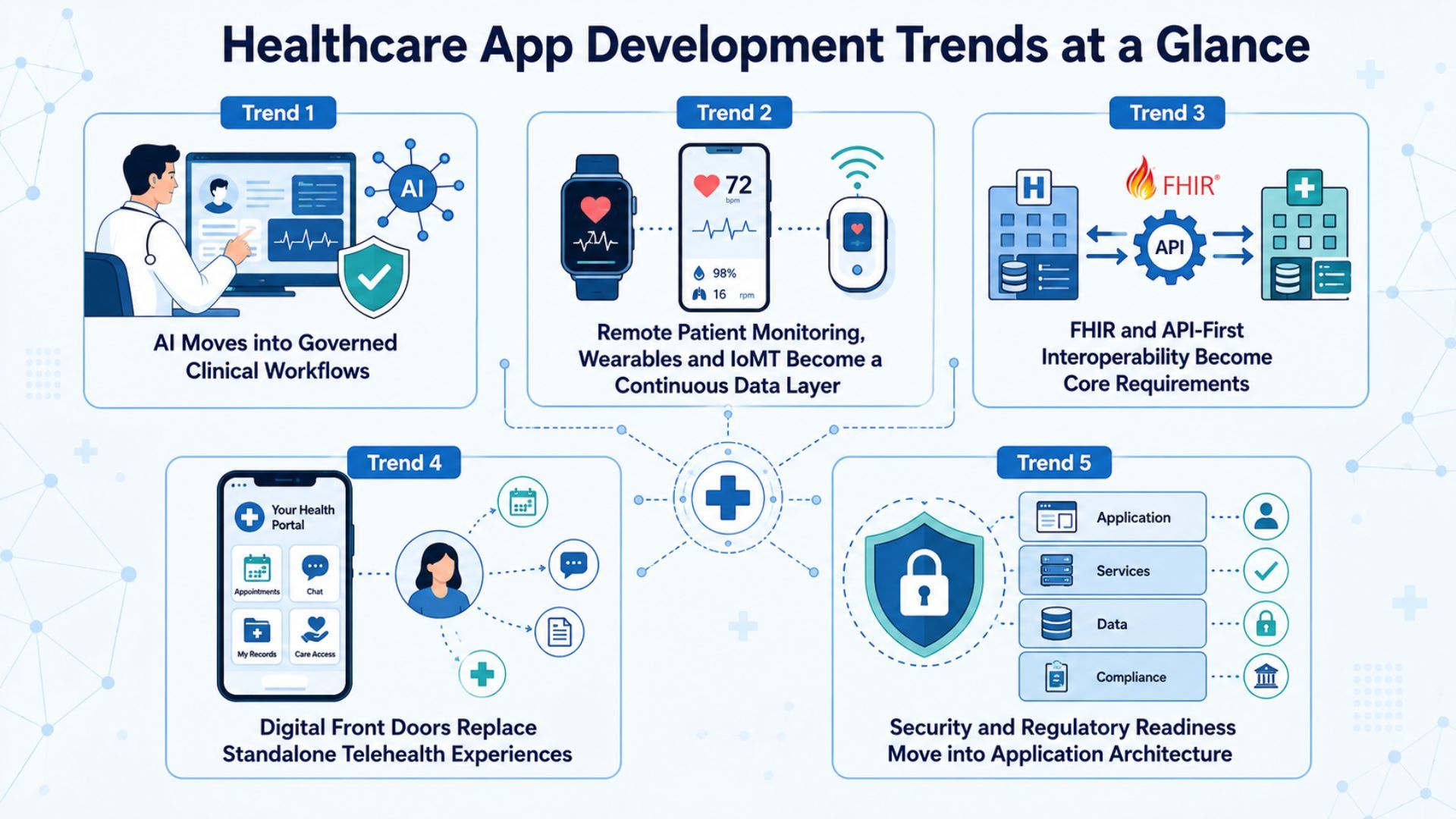
Healthcare App Development Trends at a Glance
The pattern across real deployments is consistent: healthcare apps are moving from standalone features toward coordinated systems of engagement, data exchange and clinical operations. The cases in the table anchor each trend in a current implementation or regulatory signal rather than a speculative forecast.
Trend | Business impact | Development implication | Real-world signal |
AI in governed workflows | Reduce documentation and workflow friction | Human review, validation, audit trails and model monitoring | Intermountain Health |
RPM, wearables and IoMT | Extend care beyond facilities | Reliable device ingestion, alert logic and EHR integration | Mayo Clinic |
FHIR and API-first interoperability | Connect apps to payer and provider data | FHIR profiles, OAuth, consent and data mapping | CMS Blue Button / CMS-0057-F |
Digital front doors | Unify patient access and self-service | Identity, orchestration and cross-service UX | NHS App |
Security and regulatory-ready architecture | Protect trust and continuity of care | Least privilege, encryption, logging and threat modeling | Change Healthcare / FDA guidance |
Trend 1: AI Moves into Governed Clinical Workflows
AI is becoming part of day-to-day healthcare workflows, but the important change is not simply broader access to generative models. The more consequential shift is integration into tasks where output quality, provenance and human oversight matter. Clinical documentation, summarization, patient communication, workflow routing and decision support can all benefit from AI, yet the acceptable risk profile differs sharply from a general productivity chatbot.
A healthcare application therefore needs controls around the AI feature, not just a model endpoint. Teams should define which data the model can access, which actions it can take, how generated content is labeled, when a clinician must review an output and what is recorded for later audit. Evaluation also needs to reflect the use case. Accuracy, unsupported statements, latency, failure behavior and escalation paths may all matter more than a single generic quality score.
Real-world case. Intermountain Health introduced Microsoft Dragon Copilot into clinical documentation workflows. According to Microsoft's customer story, the organization had more than 2,500 active users by the end of 2025. Microsoft also reported a 27% reduction in time spent in notes per appointment among 2,285 clinicians with at least 10 Dragon Copilot encounters, based on Epic Signal data from April 2024 through December 2025. Because this is a vendor-published case study, the result should be treated as organization-specific evidence, not a universal benchmark.
For higher-risk functions, product classification matters as well. The FDA AI-Enabled Medical Devices list provides a public view of authorized devices that the FDA has identified as AI-enabled, while explicitly noting that the list is not comprehensive. The practical lesson for medical app development is to determine early whether an AI function is merely administrative, supports clinical decisions or may fall within medical-device requirements, then design governance and validation accordingly.
Trend 2: Remote Patient Monitoring, Wearables and IoMT Become a Continuous Data Layer
Remote patient monitoring (RPM), wearables and the Internet of Medical Things are changing healthcare mobile app development from episodic interaction to continuous data handling. A patient may capture weight, blood pressure, oxygen saturation, activity or device readings at home while clinicians need only the information that is timely and actionable. That turns the mobile app into one component of a larger data pipeline rather than the final destination for the data.
The engineering challenge is reliability across the full chain. Teams must handle device identity, timestamps, intermittent connectivity, duplicates, missing values, unit normalization and secure synchronization. They also need to separate a technically abnormal reading from a clinically meaningful alert. Poorly tuned thresholds can create alert fatigue, while silent data loss can create false reassurance. Where information feeds an EHR or care-management platform, the integration and escalation workflow should be tested as rigorously as the patient-facing screen.
Real-world case. In an April 2026 report, Mayo Clinic described a 12-month RPM study involving 116 lung-transplant recipients living a median of 234 miles from the Rochester site. Patients used a home device kit to capture symptoms and physiological measures, with results transmitted to the EHR and care team. Nearly 470 alerts were generated, and about one in four prompted a change in care, such as an earlier visit, diagnostic testing, medication adjustment or emergency evaluation. This is a specific high-risk population, so it should not be generalized to every RPM program, but it illustrates why connected medical apps need dependable data flows and clinically designed alert pathways.
Trend 3: FHIR and API-First Interoperability Become Core Requirements
Healthcare apps rarely create value in isolation. They need to exchange information with EHRs, payer systems, labs, pharmacies, devices or other digital services. FHIR has become an important API-focused standard for representing and exchanging health information, but successful interoperability still requires more than sending valid JSON. Teams must map local data correctly, manage terminology, authorize users and applications, preserve consent, handle incomplete records and design for differences among implementation guides.
Real-world case. The CMS Blue Button API demonstrates what standards-based patient data access looks like in production. CMS states that Blue Button provides claims data for more than 64 million people with Medicare. The current v2 API is RESTful, based on FHIR R4 and the CARIN implementation guide, uses JSON and relies on OAuth 2.0 authorization. Access is granted on a per-user basis, which is a useful reminder that interoperability and permission design are inseparable in healthcare applications.
The direction is also regulatory. Under CMS-0057-F, affected payers have until primarily January 1, 2027 to meet API requirements related to interoperability and prior authorization. For organizations planning products in 2026, that makes API readiness a current architecture decision, not a future enhancement. A sound approach is to build integration contracts, authorization flows, auditability and test environments into the product roadmap from the beginning.
Trend 4: Digital Front Doors Replace Standalone Telehealth Experiences
Telemedicine app development is increasingly converging with a broader digital-front-door model. Patients do not experience healthcare as separate technology categories. They may want to find the right service, book an appointment, view records, message a care team, manage prescriptions and continue follow-up without jumping between disconnected tools. The strategic opportunity is therefore not simply to add more features, but to orchestrate a coherent journey across services that may be owned by different systems and teams.
This changes mHealth app development priorities. Identity and account recovery become foundational. Navigation needs to reflect patient intent rather than internal organizational structure. Appointment, pharmacy, record and messaging integrations must fail gracefully when upstream systems are unavailable. Accessibility, language support and clear escalation to human care are also core product requirements because digital access becomes a pathway into the health system itself.
Real-world case. In July 2026, NHS England described the NHS App as a digital front door through which patients can increasingly order repeat medications, check records, make or change appointments and communicate with GP services. This is much broader than a standalone video-visit application. For healthcare product teams, it illustrates why the front end, integration layer and service operations need to be designed as one experience even when multiple backend systems remain in place.
Trend 5: Security and Regulatory Readiness Move into Application Architecture
Security cannot be treated as a release checklist after a healthcare application is already designed. Connected apps expand the number of identities, APIs, vendors, devices and data flows that must be protected. For teams handling protected or clinically sensitive information, architecture decisions should include least-privilege access, encryption, secrets management, secure API design, logging, dependency management, backup and recovery, and incident response. Threat modeling should cover both the mobile or web interface and the connected ecosystem behind it.
Real-world case. The scale of ecosystem risk is visible in the Change Healthcare cyberattack. The U.S. Department of Health and Human Services reported that Change Healthcare notified the Office for Civil Rights on July 31, 2025 that approximately 192.7 million individuals had been impacted. This was not a mobile-app breach, but its breadth demonstrates why a healthcare product cannot define security only at the screen or device level. Dependencies, shared services and third-party connections can carry system-wide consequences.
For products that are medical devices or include cyber-device functionality, regulatory expectations add another layer. The FDA's February 2026 cybersecurity guidance addresses cybersecurity device design, labeling and documentation recommended for premarket submissions. The broader lesson is to determine regulatory scope early. Medical application development becomes more predictable when security evidence, validation, change control and documentation are treated as engineering deliverables throughout the lifecycle.
What These Trends Mean for Healthcare App Development Teams
The Intermountain, Mayo Clinic, CMS and NHS cases differ in purpose, but they point to the same development reality: business value is increasingly created across workflows and systems rather than inside a single app feature. A healthcare product roadmap should therefore connect experience design with architecture, data governance, testing and operational ownership.
Start with the care or business workflow, then select technology. An AI, RPM or telehealth feature is useful only when the surrounding decision and escalation process is clear.
Design interoperability as a product capability. Define data contracts, FHIR profiles where applicable, authorization, consent and failure behavior before integrations become release blockers.
Build for evidence and traceability. Log material actions, model or rule outputs, user approvals and system changes at a level appropriate to the product risk.
Test the full connected journey. Validate devices, APIs, backend services, mobile behavior, accessibility and degraded scenarios instead of testing the interface in isolation.
Plan for lifecycle change. Models, regulations, devices, third-party APIs and clinical workflows evolve. Architecture and QA should make controlled updates possible without destabilizing the care experience.
For organizations that need additional delivery capacity, a development partner should be evaluated on more than mobile UI skills. Relevant capabilities include integration engineering, data handling, QA, security-minded delivery and long-term product support. Explore our mobile app development services and quality assurance and testing services to see how these disciplines can support a connected healthcare product roadmap.
Building Healthcare Apps for 2026 and Beyond
The most important healthcare technology trends in 2026 are not isolated technologies. They are signs that healthcare app development is becoming a systems-engineering discipline. Intermountain shows AI moving into governed clinical work, Mayo Clinic shows remote data feeding care decisions, CMS shows interoperability becoming infrastructure, the NHS App shows patient access converging into a digital front door, and the Change Healthcare incident reinforces the cost of ecosystem-wide security risk.
For healthcare providers, MedTech companies and digital-health teams, the practical priority is to build applications that are useful at the interface and dependable underneath it. Titan Technology can support the design, development, integration and testing of scalable mobile products while working with your team around security, data and lifecycle requirements. Contact us to discuss a healthcare app development initiative or modernization roadmap.