

Finding an AI company is easy, but finding the right AI development company has become harder as almost every technology provider now claims to build AI solutions. According to Grand View Research, the global artificial intelligence market was estimated at USD 390.91 billion in 2025 and is projected to reach USD 3,497.26 billion by 2033. This rapid growth gives businesses more options, but it also makes vendor selection more complex.
A polished chatbot demo, workflow automation prototype, or simple LLM integration may look impressive in a presentation. The real test begins when AI has to work with business data, internal documents, customer records, existing systems, user permissions, and operating workflows. Gartner reported that at least 50% of generative AI projects were abandoned after proof of concept because of poor data quality, inadequate risk controls, escalating costs, or unclear business value.
That is why choosing among artificial intelligence development companies should not be based on demo quality alone. This guide helps business and technology leaders evaluate AI partners using six practical criteria, a nine-point checklist, common red flags, and essential questions to ask before signing a contract.
What Do AI Development Companies Actually Do?
AI development companies help businesses turn AI ideas into working systems. Their role is not limited to building a model or connecting an application to a large language model. A strong AI partner should help define the right use case, assess data quality, design the technical architecture, integrate AI into existing systems, test the solution, and support it after launch.
This distinction matters because many AI projects do not fail at the idea stage. They fail when the solution has to operate in a real business environment. An AI assistant may need to retrieve information from internal documents. A predictive analytics model may need clean, consistent data from multiple systems. A customer service automation tool may need to connect with CRM, ticketing, and reporting platforms. In each case, AI development requires software engineering, data engineering, security, testing, and long-term operational discipline.
Core AI Services to Look For
Most AI development services fall into several practical areas: AI consulting and use case discovery, AI application development, knowledge retrieval and contextual search, system integration, testing, and maintenance. For companies that already know what they want to build, this may include generative AI applications, AI agents, smart chatbots, virtual assistants, predictive analytics tools, intelligent automation systems, or document processing solutions.
Many business AI solutions also require retrieval-augmented generation, vector search, or hybrid search so the system can retrieve information from approved sources instead of relying only on general model knowledge. These capabilities depend heavily on data foundations, which is why Data Engineering Solutions are often part of a serious AI roadmap. The key is that AI must improve a measurable workflow or business outcome, not simply add another tool to the stack. Businesses exploring these capabilities can also review Titan’s AI Solutions to see how AI services can be applied across personalization, predictive analytics, intelligent automation, and conversational AI.
AI Consulting vs AI Development: Which Do You Actually Need?
AI consulting is useful when a business is still answering strategic questions: Which use case should come first? Is the data usable? What risks need to be controlled? Which process can create measurable value if enhanced by AI? AI development focuses on execution. A development partner helps design the system, build the application, connect the data, integrate with business platforms, test AI behavior, deploy the solution, and support future improvements.
For many companies, the best approach starts with focused discovery, then moves into development once the use case, data requirements, risks, and success metrics are clear. This is also why choosing an AI development company is different from choosing a traditional software vendor. AI projects depend on model behavior, data quality, access control, governance, integration, and evaluation, not code alone.
6 Key Criteria for Evaluating Artificial Intelligence Development Companies
When comparing artificial intelligence development companies, it is easy to focus on portfolio, pricing, team size, or demo quality. These factors matter, but they do not tell the full story. A reliable AI development partner should be evaluated by how well it can understand the business context, work with real data, manage privacy risks, integrate with existing systems, and support the solution lifecycle.
1. Technical Depth Across Multiple AI Domains
A capable AI development company should have experience across multiple AI domains, not only basic chatbot development. Many business AI projects combine several capabilities at once. A customer support solution may require natural language processing, retrieval-augmented generation, user permission control, CRM integration, and quality review. A forecasting tool may require data engineering, machine learning, dashboard integration, and continuous refinement.
The vendor should be able to explain why a specific AI approach is suitable for your operational need. In some cases, a third-party large language model may be enough. In others, the solution may need a custom model, open-source model, RAG architecture, vector search, hybrid search, or a combination of technologies. The best artificial intelligence development companies connect the right technology to the right use case.
2. Proven Delivery Track Record and Industry Fit
AI development is also an industry and workflow challenge. Financial services, healthcare, retail, logistics, SaaS, and manufacturing all use AI differently. Each sector has its own data structures, compliance expectations, operational risks, and user behaviors. A vendor that performs well in one industry may not automatically fit another.
When reviewing vendors, do not only ask how many AI projects they have completed. Ask whether they have solved similar complexity. A fintech company may need AI for fraud detection, document analysis, customer support, or risk scoring. A logistics company exploring AI forecasting should look beyond whether a vendor can build a prediction model. The stronger question is whether the vendor understands demand fluctuations, operational constraints, data quality issues, system integration, and how the outputs will be used by real teams.
3. Data Security, Privacy, and IP Protection
AI projects often require access to sensitive information, including customer records, internal documents, product data, transaction history, source code, business rules, or proprietary workflows. Security cannot be treated as a later technical detail. It should be one of the first criteria when evaluating artificial intelligence development companies.
A reliable partner should explain how data is collected, stored, processed, accessed, and protected throughout the project. This includes confidentiality, user permissions, data retention, third-party model usage, source code ownership, and IP rights. If a vendor cannot clearly answer where your data goes or whether it will be used to train external models, that is a serious warning sign.
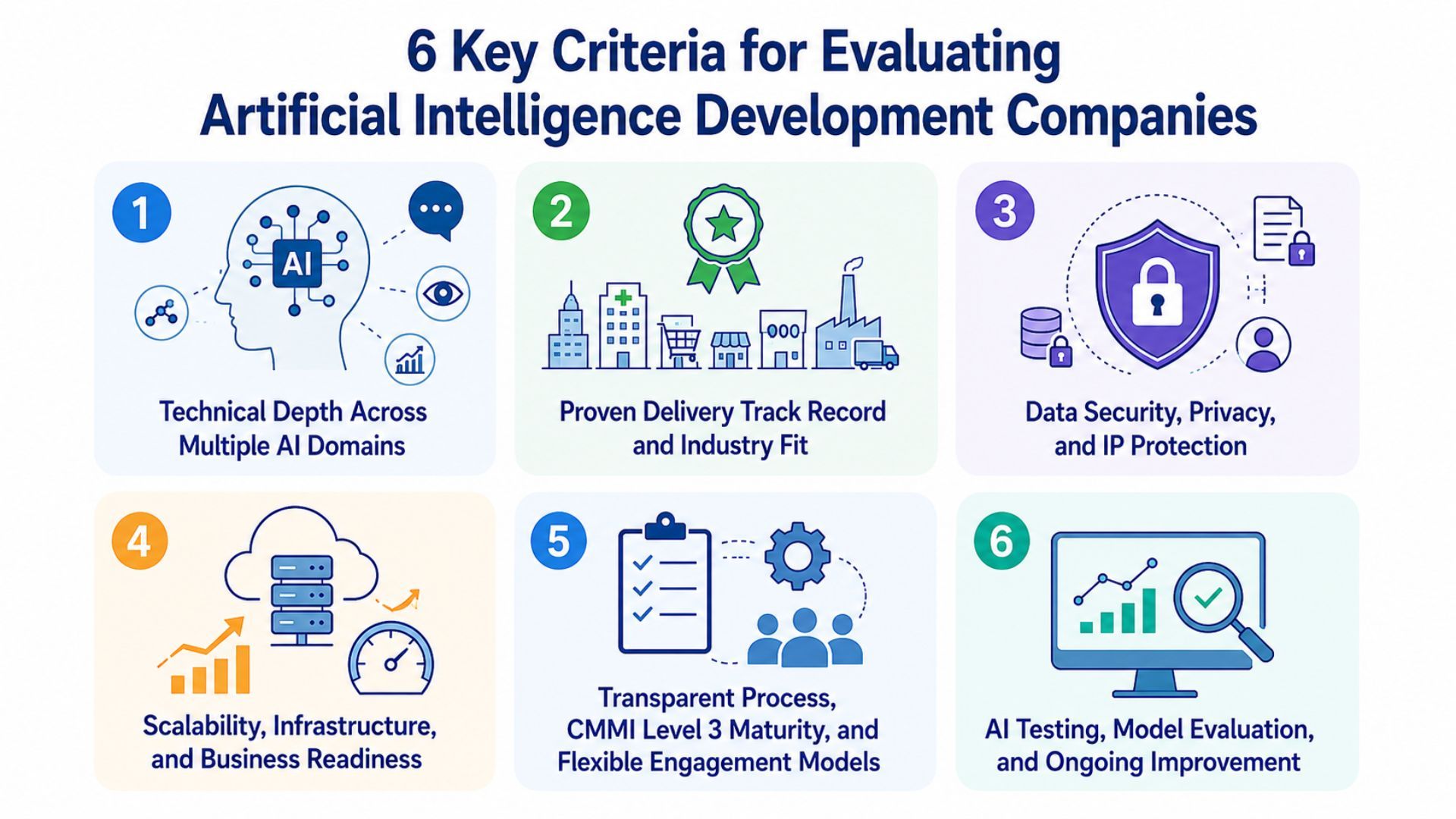
4. Scalability, Infrastructure, and Business Readiness
A proof of concept is useful, but it is only the beginning. The real value of AI appears when the solution can support real users, connect with business systems, and scale as demand grows. Scalability is not only about handling more users. It also includes response speed, infrastructure stability, data pipeline reliability, cost control, and the ability to improve the solution over time.
Consider a GenAI assistant used by a customer support team. In a demo, it may answer sample questions accurately. In daily operations, it may need to handle many queries, retrieve updated product information, respect access permissions, escalate sensitive cases, and maintain consistent response quality. When evaluating AI development companies, look for evidence that they can move from PoC to real business usage without rebuilding the solution from scratch.
5. Transparent Process, CMMI Level 3 Maturity, and Flexible Engagement Models
AI development requires close collaboration between business, product, data, security, and engineering teams. The available data may not be clean enough. The first model may not perform as expected. Integration may reveal hidden constraints in legacy systems. A mature delivery process helps both sides manage these uncertainties without losing control.
A reliable AI development company should explain how the project moves from discovery to design, development, testing, release, and improvement. For enterprise buyers, process maturity frameworks such as CMMI become relevant because CMMI Level 3 practices generally indicate standardized processes across the organization, not different ways of working from team to team.
Engagement model flexibility is another point to review. A clear AI proof of concept may fit a fixed-cost model. A project with evolving requirements may work better under Time & Material. Long-term AI product development may need a Dedicated Team model that functions as an extension of the client’s engineering team.
6. AI Testing, Model Evaluation, and Ongoing Improvement
AI systems need testing beyond standard software QA, especially when they involve generative AI, AI agents, or internal knowledge retrieval. A normal application can often be tested against fixed inputs and expected outputs. LLM-based systems behave more dynamically depending on prompt wording, user context, retrieved documents, and model updates.
For generative AI and AI agent systems, testing should include response quality, hallucination risk, unsafe answers, prompt injection, adversarial inputs, and data leakage risks. LLM attack simulation means testing how the system responds to attempts to manipulate, bypass, confuse, or extract sensitive information from the model. This makes AI evaluation closely connected to Quality Assurance Testing, not just model development.
After launch, the team should continue reviewing whether the system performs as expected. Are answers accurate? Are retrieval results coming from trusted sources? Are there repeated failed queries or rising costs? These signals help the business improve the system before small issues become larger operational problems.
A Practical Checklist for Comparing AI Development Companies
Use this nine-point checklist to compare artificial intelligence development companies before signing a contract. It is not meant to replace a full technical review, but it gives business and technology leaders a simple way to structure vendor conversations and identify gaps early.
Evaluation Area | What to Check |
Relevant AI Experience | Has the company solved similar use cases or worked with similar levels of complexity before? |
Technical Depth | Can the team support GenAI, AI agents, NLP, RAG, vector search, hybrid search, and LLM integrations when needed? |
Data Capability | Can the company assess, prepare, connect, and govern business data before development starts? |
Security & IP Protection | Are data privacy, source code ownership, IP rights, access control, and third-party model usage clearly defined? |
Business Readiness | Can the vendor deploy, maintain, and improve AI systems after launch? |
AI Testing | Can the team test hallucination, prompt injection, adversarial inputs, data leakage, reliability, and model behavior? |
Process Maturity | Does the company follow standardized delivery practices such as Agile, CMMI-based processes, or ISO-aligned security practices? |
Delivery Model | Does the vendor offer an engagement model that fits your project stage, such as Time & Material, Dedicated Team, or Fixed Cost? |
Long-Term Support | Is there a clear plan for maintenance, improvement, escalation, and knowledge transfer? |
The best choice depends on the type of AI solution you want to build, the maturity of your internal team, and the level of risk your business can accept. A startup building an AI MVP may prioritize speed and flexible scope. A financial services company may place more weight on security, auditability, and production controls. An enterprise with multiple AI use cases may need a long-term partner that can support integrations and continuous improvement.
Red Flags to Avoid When Choosing an AI Development Partner
A strong AI vendor will not avoid difficult questions. The way a company responds to concerns about data, risk, ownership, integration, and support often reveals more than its sales presentation. Watch for these warning signs when comparing vendors.
All Upside, No Tradeoffs
Be cautious when a vendor promises AI transformation without discussing limitations, risks, or operational tradeoffs. AI can create value, but every project has constraints: data quality, integration complexity, model behavior, cost, latency, or compliance needs. A reliable partner should be able to explain what AI can and cannot do in your environment.
Pushing Straight to Full Implementation Without a PoC
A vendor that pushes directly into full implementation before validating the use case, data quality, and integration requirements may create risk. For many AI projects, a focused proof of concept or MVP is not a delay. It helps test whether the model is reliable, whether users trust the workflow, and whether the solution can connect with existing systems before larger investment.
Vague Answers on Data Privacy and Ownership
Data privacy and ownership should never be unclear. If a vendor cannot explain where your data is stored, who can access it, whether it will be used to train third-party models, or what happens to your data and code when the contract ends, that should raise concern immediately.
No AI Testing or Model Evaluation Strategy
A vendor may be able to build an AI application, but that does not mean the solution is ready for real users. For LLM-based applications, testing should cover response quality, hallucination risk, prompt injection, adversarial inputs, data leakage, and unsafe outputs. If a vendor cannot explain how the AI system will be tested and evaluated, the project may not be ready for daily business use.
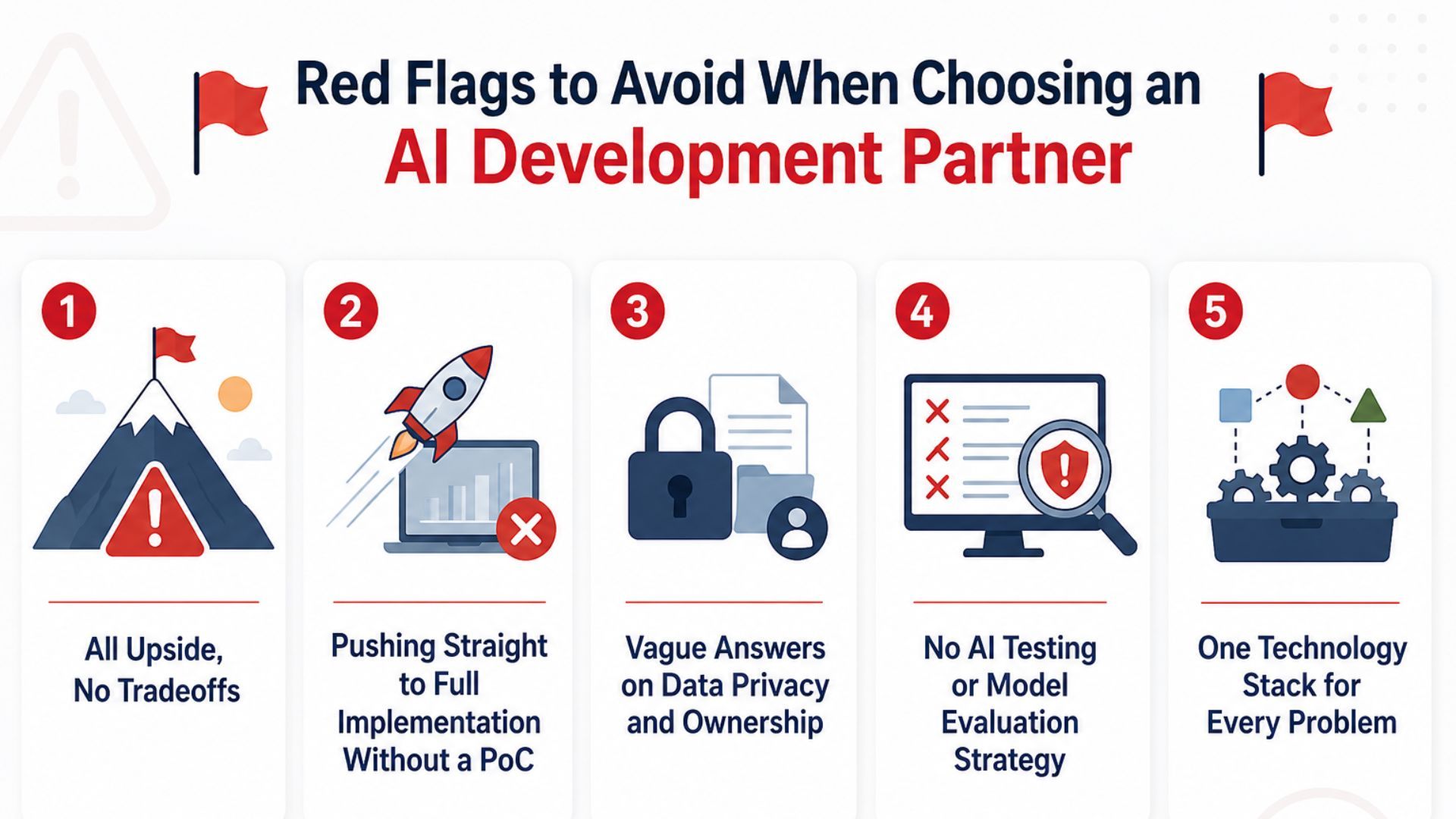
One Technology Stack for Every Problem
AI development should start with the use case, not with a preferred technology stack. Some use cases may work well with an external LLM and retrieval layer. Others may require an open-source model, traditional machine learning, rules-based automation, or a hybrid approach. If the recommendation appears before the vendor understands your data, workflow, users, and risk profile, the solution may be optimized for the vendor’s convenience rather than your outcome.
Essential Questions to Ask Before Signing with an AI Company
Once you have shortlisted a few AI development companies, ask questions that reveal how each vendor thinks, how they manage uncertainty, and how they would support your business after the first version is delivered.
Business Fit:
What business objective should we address first with AI?
How do you evaluate whether this use case is suitable for AI?
What KPIs should we track before and after implementation?
What assumptions need to be validated before development starts?
Data Privacy and Security:
What data do you need from us to start the project?
Where will our data be stored and processed?
Who can access our data during development and after launch?
Will our data be used to train any third-party model?
How do you protect source code and intellectual property?
Technical Approach and Model Ownership:
Do we need a custom model, external LLM, open-source model, RAG architecture, or hybrid approach?
How will the solution integrate with our existing systems?
How will you reduce hallucination and data leakage risks?
Will you run prompt injection or adversarial input testing?
Who owns the model outputs, source code, and documentation?
Engagement Model and Timeline:
Which engagement model fits our project: Time & Material, Dedicated Team, or Fixed Cost?
What will happen in the first 30 days?
Who will be assigned to the project?
How will scope changes be handled?
What support is included after launch?
The best partner is not always the one with the fastest estimate or the lowest price. It is the one that gives your team confidence that the project can move from business idea to working AI solution with the right level of control, security, and long-term support.
How Titan Supports AI Outsourcing and Development
Choosing the right AI development partner is not only about finding a team that understands models. It is about working with a company that can support the full journey from business discovery to software development, system integration, testing, deployment, and long-term improvement.
Titan Technology Corporation brings this broader engineering foundation to AI outsourcing and development. Founded in March 2013, the company has built its core business around software outsourcing for overseas markets and software product development through innovation and incubation. With 300+ resources, the team supports clients across full-cycle development, maintenance, monitoring, technical support, testing, and automation.
Outsourcing Maturity Backed by Global Leadership Experience
AI development becomes more reliable when it is supported by mature outsourcing delivery experience. A company may be able to build an AI prototype, but implementation often requires multiple roles working together across discovery, development, testing, integration, deployment, and support.
Beyond team size, leadership maturity is also important for international outsourcing projects. Titan’s management team brings software industry experience and global working exposure with major companies such as Deloitte, IBM, Nortel Networks, TCS, Singtel, Ruckus Wireless, Hitachi Kenki, Panasonic, and others. For enterprise clients, this background helps reinforce confidence in communication discipline, delivery governance, stakeholder alignment, and long-term partnership.
For a startup, this may mean starting with a focused AI MVP to validate product-market fit. For an enterprise, it may mean extending internal engineering capacity with AI, data, backend, QA, DevOps, and project management support. In both cases, the value is not only technical execution, but also the ability to work with a partner that understands the expectations of international business environments.
End-to-End Engineering Beyond AI Prototypes
Many AI vendors can demonstrate a chatbot or a model. Fewer can support the engineering work required to make that solution useful in a real business workflow. Titan’s service scope includes full-cycle development, maintenance, monitoring, technical support, testing, and automation. These capabilities align closely with business AI projects that require application development, API integration, DevOps support, automation testing, system documentation, and continuous enhancement.
For example, an AI assistant for internal operations may start with natural language interaction, but it will likely need access to approved knowledge bases, integration with existing tools, permission control, logging, reporting, and escalation workflows. A partner with broader Web App Development capability can help ensure the AI solution becomes part of the business process, not just a standalone experiment.
Practical AI Capabilities for Business Use Cases
Titan’s AI capability covers a practical range of business applications, including smart chatbots, intelligent document processing, natural language processing, contextual processing, AI agents, generative AI, retrieval-augmented generation, vector search, hybrid search, LLM evaluation and testing, LLM attack simulation, and external LLM integrations such as Gemini, ChatGPT, DeepSeek, and similar models.
These capabilities are relevant because enterprise AI is rarely solved by one technique alone. A customer engagement solution may require conversational AI, retrieval, CRM integration, and quality monitoring. A document automation project may require classification, extraction, validation, and human review. A knowledge assistant may require RAG, vector search, permission-aware retrieval, and LLM evaluation to reduce hallucination and data leakage risks.
Security, IP Protection, and Flexible Engagement Models
AI projects often involve sensitive information, including business data, internal knowledge bases, customer records, source code, and proprietary workflows. Titan’s corporate profile highlights well-defined security policies and training, ISMS certification aligned with ISO 27001:2022 standards, strong network and data security systems, and intellectual property protection. The company also applies CMMI Level 3 best practices and Agile development methodologies to support more predictable delivery and clearer project governance.
Different AI projects also require different cooperation models. A clearly defined proof of concept may fit a Fixed Cost model when scope and deliverables are stable. A project with evolving requirements may be better suited to Time & Material because the team needs flexibility to explore data, refine architecture, and adjust priorities. For long-term product development or continuous AI improvement, a Dedicated Team model can work as a virtual extension of the client’s engineering team.
For companies comparing AI development partners, this combination of AI capability, software engineering discipline, security practices, and flexible engagement models can help reduce delivery risk while keeping the project aligned with business goals.
Ready to Find the Right AI Development Partner for Your Business?
Choosing the right AI development company is not about selecting the vendor with the most impressive demo or the lowest initial estimate. It is about finding a partner that can understand your business context, work with your data responsibly, design a practical architecture, protect sensitive information, integrate with existing systems, and support the solution after launch.
Before signing with any vendor, compare artificial intelligence development companies across the areas that matter most: technical depth, data quality, security and IP protection, business readiness, AI testing, delivery model, and long-term support. The right partner should help your team move from idea validation to measurable business impact without losing control over quality, cost, or risk.
Explore Titan’s AI Solutions to see how AI can support your next stage of Digital Transformation.