

Choosing a software outsourcing company involves more than reviewing portfolios, comparing hourly rates, or evaluating sales presentations. A provider may demonstrate strong technical capabilities yet lack the security controls, delivery governance, or commercial flexibility your project requires.
A structured evaluation helps decision - makers distinguish credible capabilities from unverified claims.
This guide explains six practical due diligence steps for evaluating software outsourcing providers, followed by a checklist to help compare shortlisted vendors. The approach emphasizes verifying evidence, identifying unacceptable risks, and assessing each provider against your project's requirements.
Although written from the perspective of a software outsourcing provider, the criteria can be applied to any vendor, including the company publishing this guide.
Why Software Outsourcing Due Diligence Matters
Vendor screening and due diligence serve different purposes.
Screening identifies companies that appear suitable based on their services, experience, location, and pricing. Due diligence examines whether their claims are supported by reliable evidence and whether their operating practices match your requirements.
Risks such as inadequate access controls, unexpected subcontracting, undocumented dependencies, or unclear intellectual property ownership may not be visible in a proposal.
The NIST Cybersecurity Supply Chain Risk Management guidance, updated in November 2024, provides a reference for identifying and managing risks associated with external technology suppliers.
For software outsourcing decisions, a useful principle is:
Claim → Evidence → Verification
Rather than accepting a vendor's statement that it has extensive enterprise experience, request relevant project evidence and verify its actual role, responsibilities, and outcomes.
Six-Step Software Outsourcing Vendor Evaluation Framework
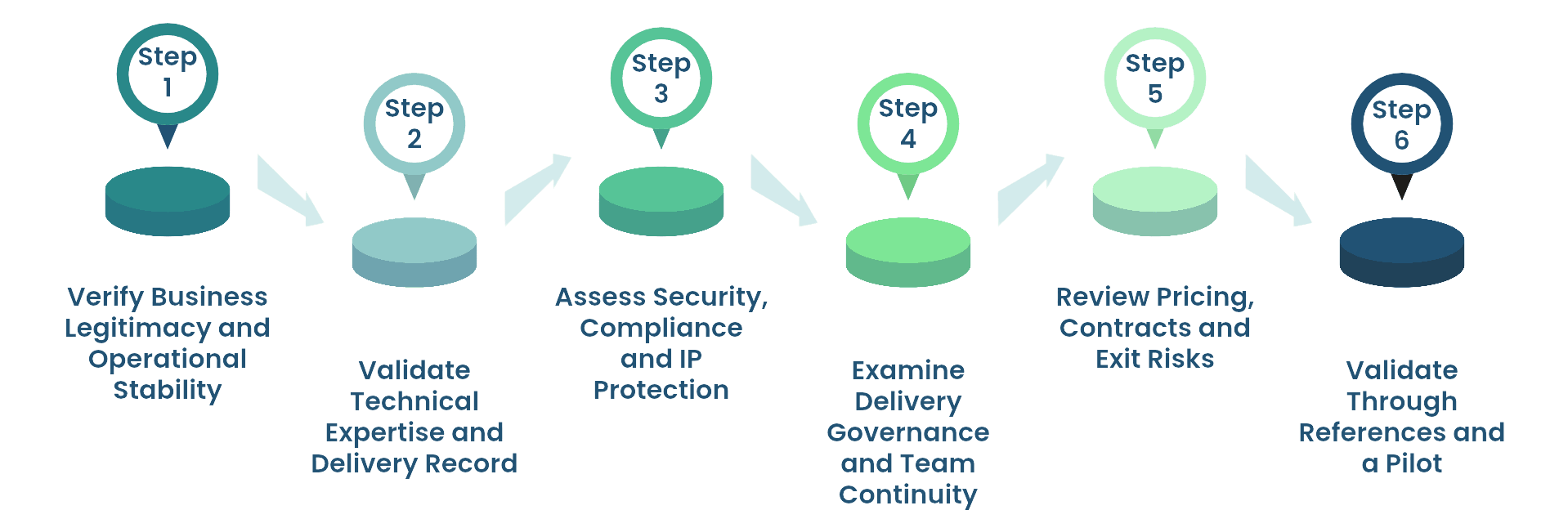
The following six steps examine business stability, technical capabilities, security, delivery practices, commercial terms, and practical performance.
Each step distinguishes what the vendor claims, what evidence supports that claim, how the buyer can verify it, and which warning signs require further investigation.
1. Verify Business Legitimacy and Operational Stability
Claim to test: The vendor is a legitimate organization capable of supporting the project throughout its expected lifecycle.
Evidence to request: Business registration details, the legal entity responsible for contracting, relevant operating history, and business continuity arrangements.
How to verify: Confirm the company's registration through an appropriate official registry. Check whether the contracting entity matches the organization responsible for delivery and invoicing.
For a substantial or long-term engagement, request proportionate evidence of financial and operational stability. This might include continuity planning, key-person dependency controls, or information about how the vendor would maintain delivery during a disruption.
What to watch for: Inconsistent legal information, unexplained differences between sales and contracting entities, or an inability to explain how critical project knowledge would be preserved.
A smaller company should not automatically receive a lower assessment. The relevant question is whether its operating capacity and resilience match the project's scale and risk.
2. Validate Technical Expertise and Delivery Record
Claim to test: The vendor has experience delivering projects with comparable technical and business requirements.
Evidence to request: Relevant case studies, architecture examples, technical documentation, delivery responsibilities, and access to the proposed technical lead.
A case study should explain more than the technologies used. Ask what the provider actually developed, which systems it integrated, how technical decisions were made, and which responsibilities remained with the client.
How to verify: Conduct a technical interview focused on a real implementation challenge. Ask the proposed lead to explain architecture trade-offs, integration constraints, testing decisions, and lessons learned.
Illustrative scenario: A company is evaluating an outsourcing vendor to integrate its CRM with an existing ERP system. Rather than accepting a general claim of integration expertise, the buyer asks the proposed technical lead to explain how customer records would be synchronized, how conflicting updates would be resolved, and how failed transactions would be recovered.
The vendor's answers, supported by a sample architecture or technical exercise, provide more useful evidence of relevant expertise than a list of technologies alone.
What to watch for: Generic project descriptions, unexplained performance claims, or technical representatives unable to discuss the implementation in sufficient detail.
The objective is to verify relevant expertise rather than reward the largest portfolio.
3. Assess Security, Compliance and IP Protection
Claim to test: The vendor can protect your software, data, intellectual property, and development environment.
Evidence to request: Relevant security policies, access management procedures, incident response arrangements, intellectual property provisions, and applicable certifications.
If the vendor holds ISO/IEC 27001 certification, examine its scope and validity rather than relying on a certification logo. Where appropriate, request a relevant summary or controlled review of its Statement of Applicability. Verify certificate details with the issuing certification body or an appropriate verification service.
How to verify: Ask how the vendor manages repository permissions, credentials, development environments, security testing, and access removal when team members leave.
For application development, the NIST Secure Software Development Framework provides useful practices for discussing secure development. The OWASP Application Security Verification Standard offers requirements that can inform application security verification.
Also examine policies governing AI-assisted coding. Determine which tools are approved, whether customer code may be submitted to external services, and how data retention is controlled.
For international engagements, assess applicable data protection requirements and cross-border processing arrangements with appropriate legal support.
What to watch for: Unclear ownership of source code, uncontrolled production access, inadequate incident escalation, or security claims unsupported by relevant evidence.
4. Examine Delivery Governance and Team Continuity
Claim to test: The vendor can deliver predictably while maintaining accountability and project knowledge.
Evidence to request: Proposed team structure, responsibility assignments, reporting procedures, escalation paths, and personnel replacement arrangements.
How to verify: Ask who will own architecture, development, testing, releases, and communication. Review a sample responsibility matrix, such as a RACI, and confirm how decisions and requirement changes will be documented.
Interview the individuals expected to work on the project, not only senior specialists involved in presales discussions.
Explore how the provider manages employee turnover, subcontractors, onboarding, and knowledge transfer. For longer engagements, understanding how documentation and shared ownership reduce dependence on individual developers.
What to watch for: Unclear accountability, frequent changes to the proposed team, or an inability to explain how work continues when a critical contributor becomes unavailable.
Strong governance should support collaboration without introducing unnecessary bureaucracy.
5. Review Pricing, Contracts and Exit Risks
Claim to test: The commercial proposal accurately represents the work, responsibilities, and risks involved.
Evidence to request: Detailed pricing assumptions, scope exclusions, change request procedures, service levels, acceptance criteria, and contractual terms.
How to verify: Compare proposals against the same requirements. Determine whether estimates include regression testing, deployment, documentation, security activities, and transition support.
Illustrative scenario: Vendor A submits a lower development estimate but excludes automated regression testing and production deployment. Vendor B includes both activities. Comparing headline prices alone would not reflect the full expected cost.
Review intellectual property ownership, confidentiality, data return, termination rights, warranty obligations, and exit assistance. Applicable law and dispute resolution arrangements also require attention, particularly in cross-border engagements.
Different software outsourcing models distribute responsibilities and financial risks differently. The contract should reflect the selected delivery model and the degree of flexibility the buyer needs.
What to watch for: Vague exclusions, unclear acceptance procedures, restrictive termination provisions, or unresolved ownership of deliverables.
6. Validate Through References and a Pilot
Claim to test: The vendor can demonstrate its capabilities under conditions relevant to your project.
Evidence to request: Client references with appropriate permission, sample deliverables, or results from a limited technical exercise.
How to verify: Speak with references whose projects resemble your own. Ask about communication, change management, technical challenges, and support after release.
For shortlisted vendors, consider a paid pilot or discovery sprint with predefined acceptance criteria.
In a hypothetical SaaS project, a pilot might involve developing a small module that integrates with an existing API, includes automated tests, and passes through a CI/CD pipeline.
Evaluate technical quality alongside communication, documentation, and issue resolution.
What to watch for: References unrelated to the proposed work, undefined pilot success criteria, or reluctance to explain implementation decisions.
A workshop can provide useful evidence, but it should not automatically be treated as equivalent to a working pilot.
How to Compare Shortlisted Software Outsourcing Vendors
Once you have completed the six due diligence steps, compare shortlisted vendors using the same evaluation criteria. The goal is not to identify the company with the most impressive presentation, but to determine which provider can demonstrate the capabilities and controls your project requires.
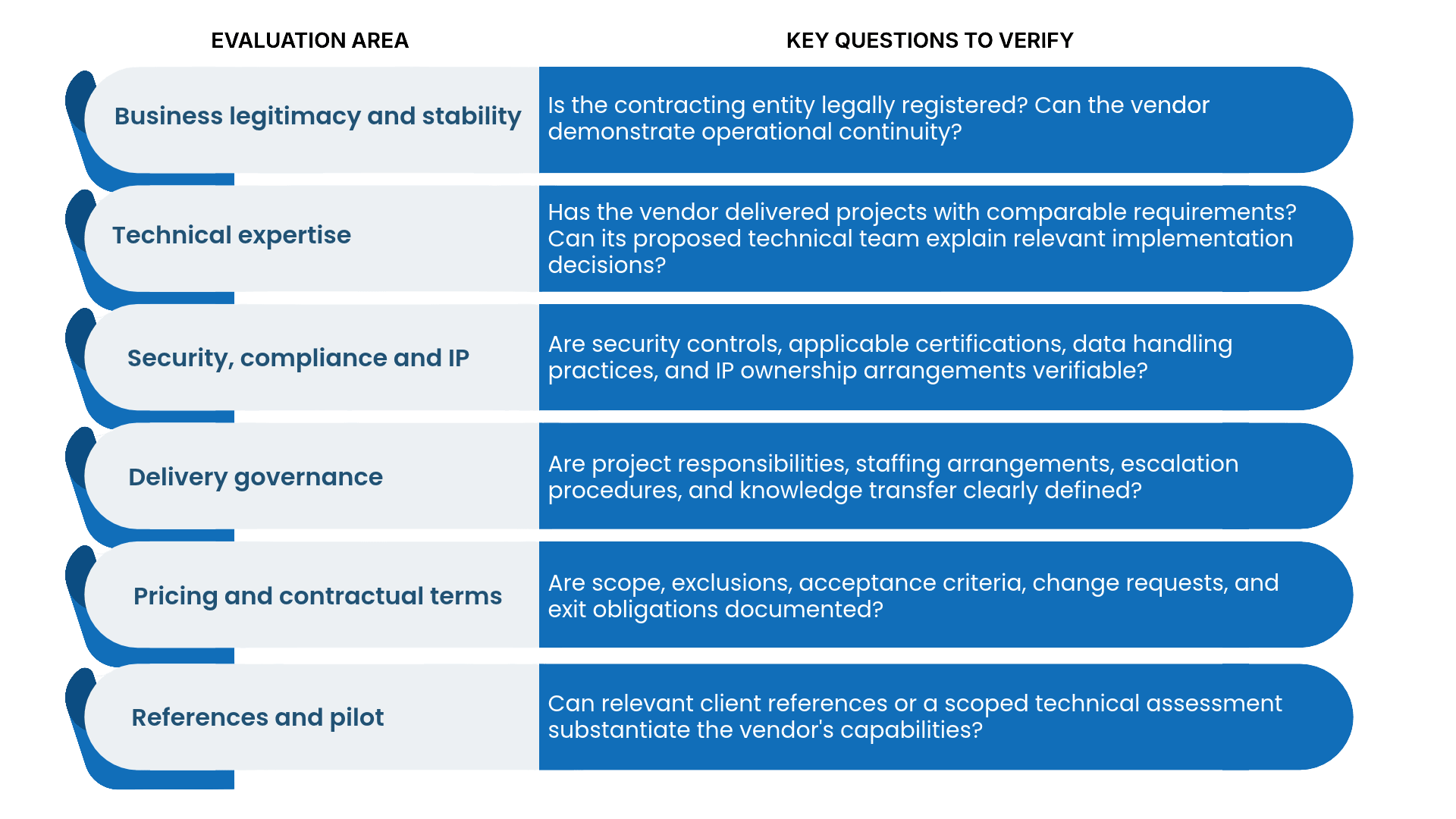
The following checklist translates the six evaluation areas into practical questions.
Separate Mandatory Requirements from Areas for Comparison
Not every requirement should be treated equally.
Some conditions, such as legal contracting requirements, mandatory security controls, or intellectual property protections, must be satisfied before a vendor can be approved. Strong technical capabilities should not compensate for failing these requirements.
Other conditions may be addressed through clarification, additional evidence, or agreed remediation. Record each outstanding issue, its owner, the required action, and the deadline for resolution.
For requirements that are not mandatory, compare the strength and relevance of the available evidence. A vendor with extensive experience in your industry may be preferable to a larger provider whose portfolio is less relevant to your project.
Make the Final Comparison Evidence-Based
For each vendor, document whether the evidence is verified, partially verified, or not verified. This simple classification helps distinguish demonstrated capabilities from unsupported claims without introducing arbitrary numerical scores.
Consider the project's priorities when interpreting the results. For example, an enterprise application processing sensitive financial information may require stronger security evidence than an internal prototype.
Use the checklist to identify remaining uncertainties, determine whether a reference call or pilot is necessary, and document the rationale behind the final decision.
Red Flags That Should Trigger Further Investigation
Certain warning signs warrant additional verification before contract approval:
Unsubstantiated project claims: The vendor cannot explain or support relevant delivery experience.
Inconsistent staffing: Interviewed specialists are not part of the proposed delivery team.
Unclear intellectual property terms: Ownership of code, documentation, or customer data remains unresolved.
Weak continuity arrangements: There is no credible process for knowledge transfer, personnel replacement, or incident escalation.
Incomplete pricing: Material assumptions, exclusions, or transition costs are missing.
These are reasons to investigate further, not automatic evidence of misconduct or poor performance. Their significance depends on the project's requirements and the vendor's response.
From Due Diligence to a Confident Decision
A final outsourcing decision should reflect verified evidence, mandatory requirements, and the risks that remain unresolved.
Before approving engagement, confirm that the selected vendor meets all non-negotiable conditions and that contractual responsibilities, acceptance criteria, and outstanding actions are documented.
Where uncertainty remains, consider additional reference checks, technical discussions, or a scoped pilot before committing to a larger engagement.
Establish a clear onboarding plan, including team responsibilities, system access, communication procedures, and knowledge transfer expectations.
A structured evaluation does not eliminate outsourcing risk. It helps decision - makers understand trade-offs and select a partner based on demonstrated capabilities rather than assumptions.
Conclusion: Choosing a Software Outsourcing Partner for Long-Term Value
The right software outsourcing company is not necessarily the provider with the lowest rates, largest engineering team, or most impressive portfolio.
It is the organization whose technical capabilities, security practices, delivery processes, and contractual commitments can be verified against your specific requirements.
A consistent due diligence process helps businesses compare potential partners, identify unresolved risks, and make more informed outsourcing decisions.
If your organization is evaluating potential software outsourcing partners, explore our software development and outsourcing services, or contact our team to discuss your project requirements and find the right development approach for your business.