

Healthcare organizations generate data across electronic health records (EHRs), laboratory systems, medical imaging, scheduling, and billing applications. Integrating these sources into reliable insights is challenging when systems use different formats and follow different governance requirements.
A cloud-based data analytics platform can improve reporting and operational decision-making, but choosing one requires more than comparing technical features. Healthcare IT leaders must consider analytical workloads, interoperability, patient data protection, and long-term operating costs.
This guide explains the main platform approaches and practical criteria for selecting a healthcare analytics solution.
Why Healthcare Analytics Requires a Different Evaluation Approach
Healthcare data comes from systems designed for different clinical and administrative purposes. Combining EHR records, laboratory results, imaging information, and operational data requires consistent patient identification, accurate timestamps, and preserved clinical context.
Privacy and governance requirements add complexity. Data used for operational reporting may require different access controls from information used for research or direct patient care. Platform evaluation should therefore consider analytical objectives, integration architecture, and regulatory responsibilities together.
Start With the Healthcare Decisions Your Platform Must Support
Platform selection should begin with defined analytical requirements. A hospital network may prioritize patient flow, appointment utilization, and resource planning, while a research organization may need longitudinal datasets or advanced processing.
Operational Reporting and Resource Planning
Operational dashboards may combine scheduling, encounter, and financial data across facilities. Teams should define reporting frequency, source systems, and acceptable latency before selecting an architecture.
Clinical Quality and Population Health Analytics
Clinical quality reporting may require combining diagnoses, encounters, and laboratory observations over time. Reliable results depend on consistent definitions, patient matching, and traceable transformations. These requirements should guide platform evaluation.
Healthcare Analytics Platform Types and When Each Fits
There is no single architecture suitable for every healthcare analytics workload. Cloud data warehouses, lakehouses, managed healthcare data services, and hybrid or federated approaches address different requirements and can be combined within the same environment.
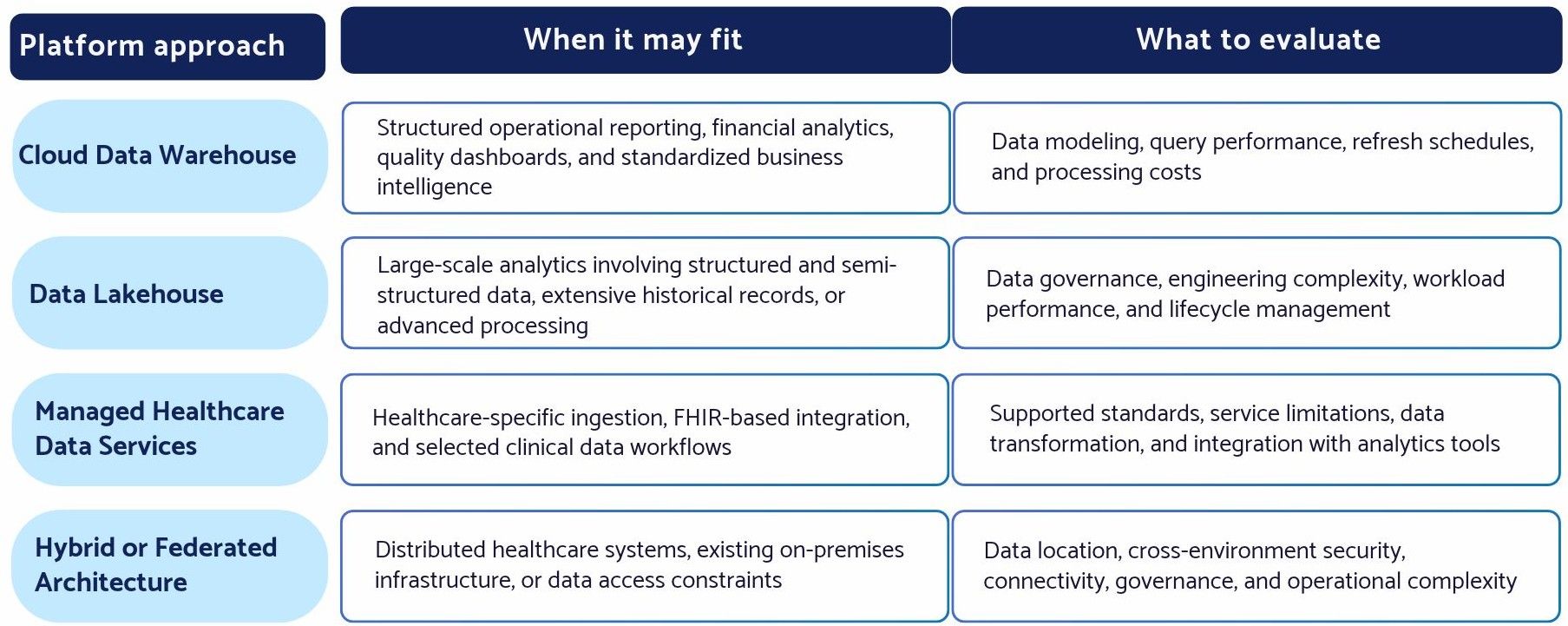
These approaches are not mutually exclusive. Managed healthcare data services may support interoperability while a warehouse or lakehouse handles downstream analysis. Hybrid and federated architectures describe how components and data are distributed rather than representing separate analytical database categories.
When a Cloud Data Warehouse Is a Practical Choice
A cloud data warehouse may be appropriate when an organization's primary objective is consistent reporting across structured datasets. For example, a hospital group could integrate scheduling, billing, and encounter information into standardized analytical tables used by finance and operations teams.
The evaluation should focus on whether the warehouse supports the required transformations, reporting frequency, concurrent users, and query performance at an acceptable operating cost. It should also account for the engineering work needed to maintain reliable source-to-reporting data flows.
When a Data Lakehouse May Be More Suitable
A lakehouse can be useful when healthcare analytics involves diverse data formats or workloads that extend beyond conventional reporting. An organization may need to process structured EHR extracts alongside large historical datasets, semi-structured event records, or information prepared for advanced analytical models.
This flexibility comes with operational responsibilities. Data modeling, access controls, quality checks, and pipeline maintenance remain necessary, so organizations should assess whether their engineering teams can manage the additional complexity.
When Managed Healthcare Data Services Add Value
Managed healthcare data services can simplify selected integration tasks, particularly when organizations need to ingest, store, or exchange healthcare information using standards such as FHIR. These services may reduce the infrastructure work associated with healthcare-specific data interfaces, although their suitability depends on supported standards, available regions, integration capabilities, security controls, and compatibility with downstream analytical workloads.
Healthcare organizations should assess these services as components of a broader data architecture rather than assuming they provide a complete analytics environment. Depending on the use case, managed healthcare data services may work alongside a cloud data warehouse, lakehouse, or other analytical infrastructure.
When Hybrid or Federated Approaches Make Sense
Healthcare organizations with established on-premises systems, distributed facilities, or restrictions on moving sensitive information may need a hybrid or federated architecture.
A hybrid environment can combine cloud analytics with existing infrastructure, while a federated approach may enable authorized analysis across separate data environments without requiring all source data to be centralized. These designs introduce considerations involving connectivity, identity management, governance, and performance, so their value should be assessed against specific organizational constraints.
The practical decision is architectural: which combination of components can support the required data flows, analytical workloads, governance obligations, and operating model?
Evaluate Healthcare Data Integration and Interoperability
Healthcare analytics platforms must accommodate existing interfaces, data structures, and access restrictions.
Support the Standards Used by Existing Systems
HL7 FHIR supports standardized healthcare data exchange. However, many hospital systems also use HL7 Version 2 for admissions, orders, and laboratory information. DICOM supports medical imaging, while the OMOP Common Data Model provides a standardized structure for certain observational health data analytics.
A February 2026 ASTP report found that approximately nine in ten U.S. non-federal acute care hospitals enabled API-based patient access in 2024. Yet EHR data exchange with third-party technologies continued to rely predominantly on non-standards-based approaches.
Organizations should evaluate the integration methods used by their existing systems rather than relying solely on advertised standards support.
Validate Patient Identity and Data Consistency
Facilities may use different patient identifiers, terminology, and encounter definitions. Platforms should support reconciliation, validation, and data lineage while preserving clinical context and making uncertain matches reviewable.
Assess Patient Data Security, Privacy, and Governance
Security evaluation should address technical safeguards, contractual responsibilities, and applicable healthcare regulations.
Understand HIPAA and Shared Responsibilities
For U.S. organizations subject to HIPAA, cloud services handling electronic protected health information (ePHI) must meet applicable requirements.
The U.S. Department of Health and Human Services' guidance explains cloud-related responsibilities, including Business Associate Agreements (BAAs) when required.
Organizations should evaluate encryption, access controls, audit logging, incident response, and vendor responsibilities. Legal and compliance professionals should review applicable obligations before deployment.
Evaluate Data Residency and Cross-Border Processing
Healthcare teams should verify where information is stored, processed, backed up, and accessed. HIPAA does not generally require ePHI to remain in the United States, but international processing can introduce additional risks.
UK and Australian organizations should consider relevant guidance from the Information Commissioner's Office and Office of the Australian Information Commissioner. Healthcare-specific requirements may impose further obligations, which should be confirmed with legal counsel.
Apply Privacy Controls to Analytical Workloads
Aggregated or appropriately de-identified data may support certain analytics without exposing directly identifiable patient information.
Real-world example: Mayo Clinic Platform
Mayo Clinic Platform Connect uses a Data Behind Glass approach to support controlled access to de-identified data across a federated network. Although primarily focused on research and AI, it illustrates the importance of privacy-by-design.
Verify Data Quality, Reliability, and Analytics Performance
Reliable healthcare analytics requires accurate data, monitored pipelines, and recoverable infrastructure.
Data Quality and Lineage
Platforms should identify missing fields, duplicates, and inconsistent definitions. For example, appointment utilization reporting must distinguish completed visits from cancellations. Data lineage helps teams trace discrepancies to their sources.
Pipeline Monitoring and Recovery
Pipelines should detect failures, support controlled retries, and prevent duplicate or incomplete reporting. These capabilities are central to effective data pipeline development, regardless of platform choice.
Availability, Backup, and Disaster Recovery
Organizations should define recovery time objectives (RTOs) and recovery point objectives (RPOs). Evaluation should cover backup frequency, restoration testing, regional outages, and recovery of datasets, configurations, and pipelines.
Performance Against Real Healthcare Workloads
Performance testing should use representative data volumes, query patterns, and concurrent users. Requirements will differ between periodic reporting and time-sensitive operational monitoring.
Consider Scalability, Operating Costs, and Internal Capabilities
Long-term suitability depends on operating costs, engineering resources, and architectural flexibility.
Estimate the Full Cost of Ownership
Costs may include ingestion, storage, processing, transfers, monitoring, licensing, and maintenance. Estimates should account for growth in facilities, data sources, and users.
Assess Internal Engineering Capabilities
Some platforms require substantial modeling, orchestration, and pipeline maintenance. Managed services reduce certain infrastructure tasks but may introduce dependencies. Organizations should assess their ability to operate the selected architecture.
Consider Portability and Future Requirements
Teams should evaluate export formats, migration options, and dependencies before committing to a platform. Understanding these constraints helps manage future technology changes.
Validate the Platform Through a Focused Healthcare Use Case
A focused pilot can test platform suitability before a larger investment.
For example, an illustrative hospital network could integrate scheduling and encounter data from two facilities to measure appointment utilization and cancellations. Success criteria might include data completeness, reconciliation accuracy, reporting latency, access controls, and recovery procedures.
Where appropriate, synthetic, properly de-identified, or otherwise authorized data should be used. Teams should document unresolved limitations and operational responsibilities before expanding deployment.
Questions to Ask Before Selecting a Healthcare Analytics Platform
Vendor evaluation should focus on evidence rather than general feature descriptions.
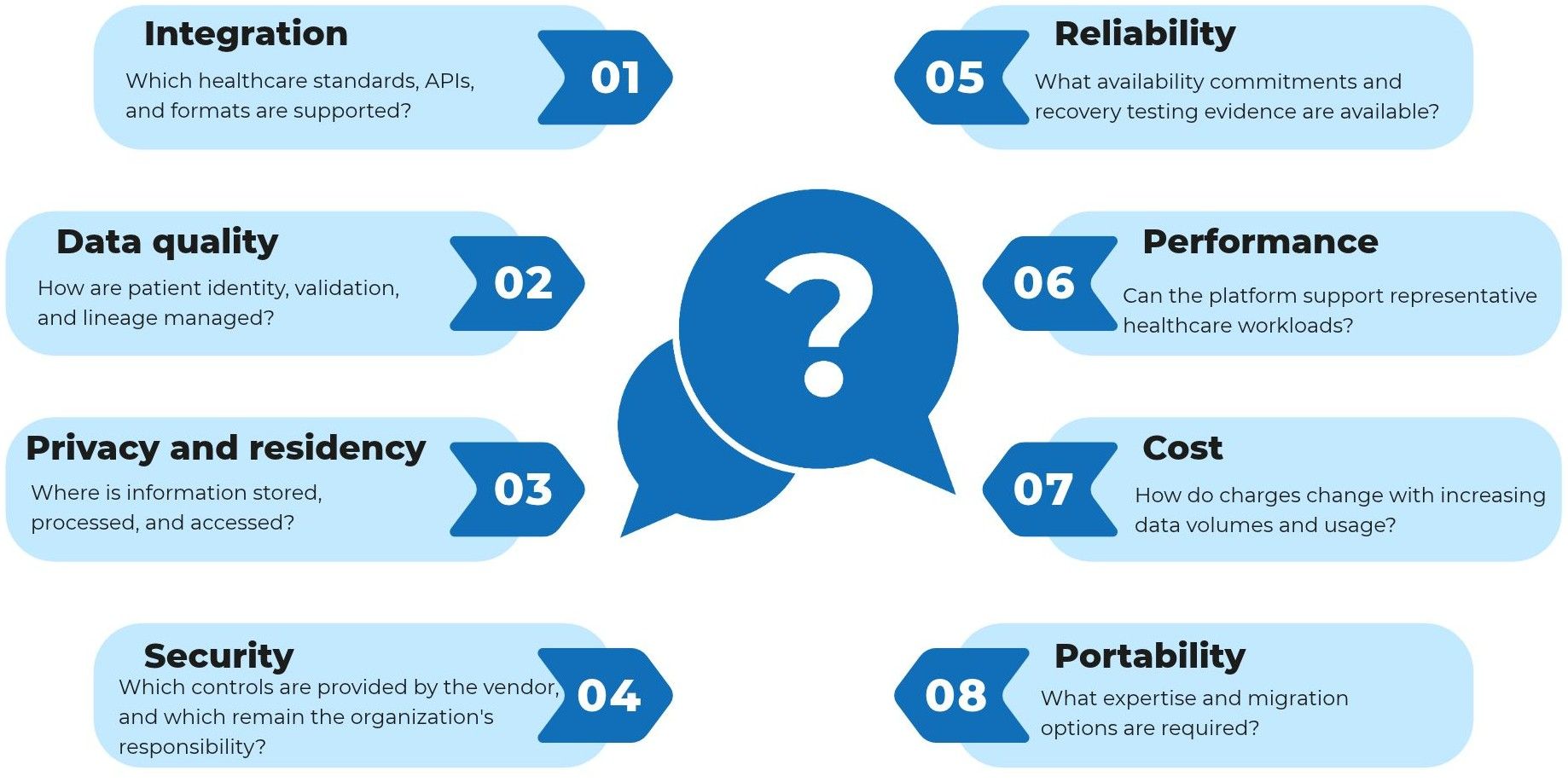
Vendor responses should be supported by technical demonstrations, contractual review, and pilot results where appropriate.
Choosing a Healthcare Analytics Platform That Supports Long-Term Value
The right cloud-based data analytics platform depends on analytical objectives, existing systems, governance obligations, and operational capabilities.
A warehouse may suit structured reporting, while lakehouse, managed healthcare data services, or hybrid approaches may support more complex requirements. Regardless of architecture, organizations should validate interoperability, security, reliability, and long-term costs.
Platform selection is only the beginning. Healthcare organizations still need reliable integration, data transformation, and pipeline operations to produce consistent insights.
Explore our Data Engineering Solutions to learn how experienced data professionals can support integration, pipeline development, and analytics infrastructure initiatives, or contact our team to discuss your project requirements and find the right development approach for your business.