

Summary
AI chatbots fail frequently post-launch, with 40% of issues caused by gaps automated testing cannot detect.
Manual QA catches nuanced problems such as tone mismatches, broken logic, cultural errors, and emotional misinterpretations.
Startups, PMs/CTOs, product owners, and outsourcing vendors all benefit from human testers who spot issues accelerated timelines often overlook.
Case studies show manual testing improves real-world performance — e.g., Pricefx saw 4× higher engagement and a 17% increase in booked meetings after manual QA.
Human-led testing ensures chatbots handle real user behavior, edge cases, and brand-aligned communication before going live.
AI chatbots have evolved from being a nice-to-have feature to a core part of modern digital ecosystems. From customer support and sales to onboarding and feedback collection, these bots are central to how businesses interact with customers. However, this central role comes with heightened expectations. Users demand that chatbots be fast, helpful, and surprisingly human.
When done right, the impact can be transformative. In one recent case, implementing AI agents led to a 30% increase in sales conversions within just 6 months, driven by personalized recommendations and faster response times. Customer satisfaction scores also saw a notable rise of 20%, as highlighted in our article. However, when chatbots fall short—misunderstanding queries, providing awkward responses, or behaving unpredictably—the consequences can be just as dramatic.
It’s not just about user frustration. A poor chatbot experience can erode trust, damage your brand’s reputation, and cost you real revenue. Research by Forbes shows that 30% of customers will abandon a brand after a single negative chatbot interaction. Worse yet, 40% of chatbots fail post-launch due to issues that weren’t identified before going live.
This is why manual testing is essential. While automated testing can catch some errors, real human testers are needed to detect the nuanced problems automation simply can’t handle—such as awkward phrasing, emotional tone inconsistencies, logic breakdowns, and cultural misfires.
At Titan Technology Corporation we’ve seen firsthand how much of a difference human-led QA can make—especially in critical moments where AI bots must perform reliably.
In this article, we’ll dive into four high-stakes scenarios where manual, human-led chatbot testing isn’t just helpful—it’s a game-changer.
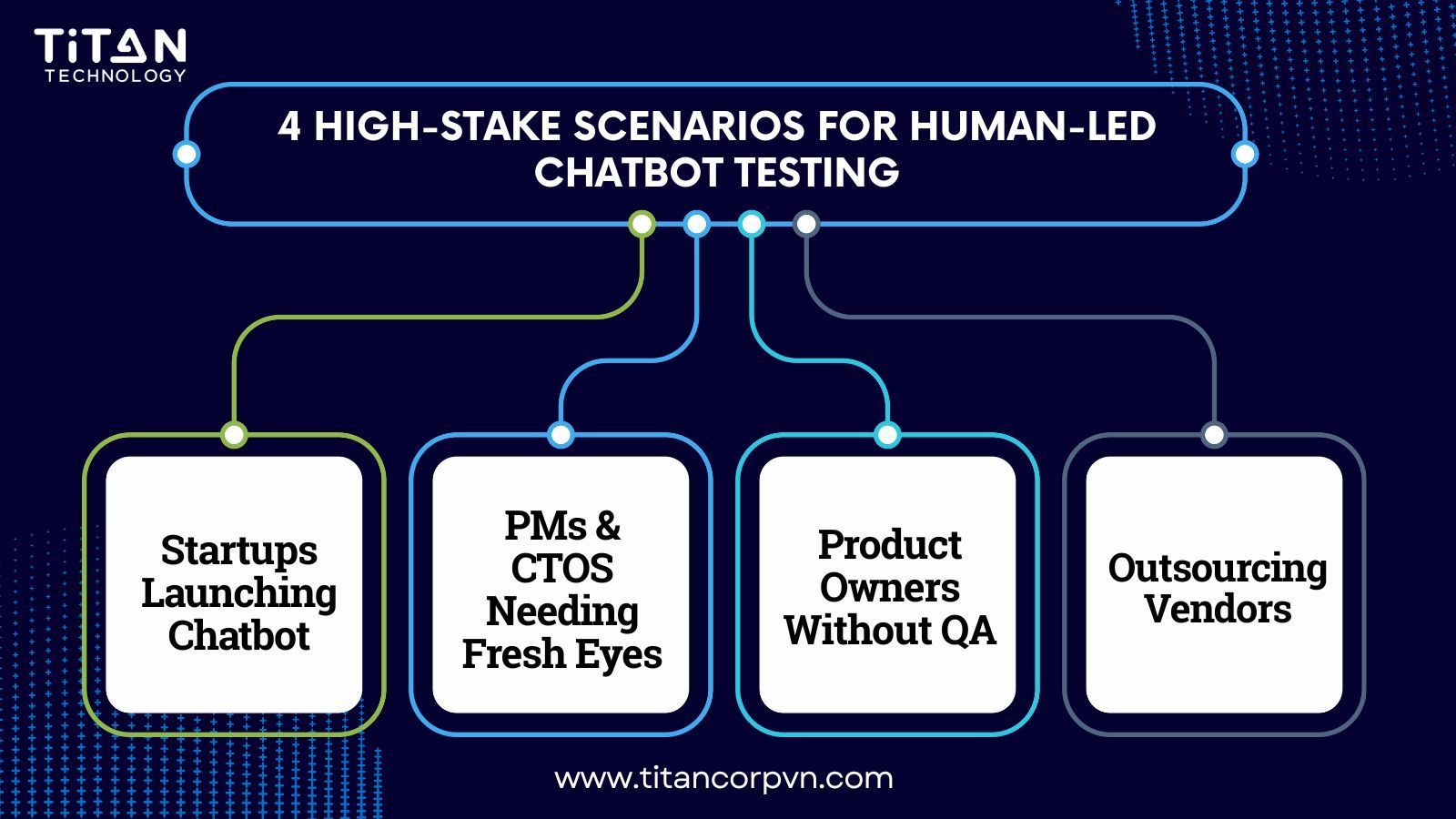
1. Startups Launching Their First Chatbot: Moving Fast, But Missing Critical Risks
Startups are built on speed and agility. The goal is to launch quickly, get feedback, and iterate. However, this rush to the market can lead to overlooking crucial testing stages. In fact, startups may delay comprehensive chatbot testing due to limited resources, leaving major risks unchecked.
According to CB Insights, 17% of startups fail due to product misalignment with market needs, and an additional 8% fail due to product-related issues, totaling 25%. These statistics highlight the critical importance of thorough testing and aligning product development with user expectations to ensure startup success.
Where Manual Testing Helps:
Simulating Real Conversations: Startups often don’t have enough live user data to test the chatbot properly. Manual testers can fill this gap by simulating real interactions, including the use of slang, typos, or vague phrasing.
Tone and Brand Consistency: In the race to release a product, the chatbot’s tone often becomes an afterthought. Manual testers ensure that the chatbot maintains a consistent voice that aligns with the brand’s messaging and communicates naturally.
Identifying Logic Gaps: Early versions of a chatbot can suffer from incomplete logic paths. Manual testers can identify breaks or dead ends in decision trees that automation might miss.
In a startup’s case, user feedback is a lifeline, and the success of the chatbot often hinges on real-world testing. Without it, even the smallest gap in performance could derail the project.
For example, an early-stage project called AirTrackBot used a simple AI chatbot on Telegram to help users monitor flight prices. In its first week, it gained 10,000 users—and scaled to over 900,000 with minimal team resources. The success hinged not just on the idea, but on delivering responses that felt helpful, clear, and timely. A rushed or untested chatbot experience would have eroded trust quickly — as highlighted in this case study.
This demonstrates how even lightweight chatbots in startup settings must perform reliably under real-world user behavior—exactly where manual testing adds value.
2. PMs & CTOs Needing Fresh Eyes: Catching What Automation Misses
Even experienced PMs and CTOs can fall into the trap of tunnel vision. As development teams grow closer to the product, it becomes harder to view it objectively—as a first-time user would. This is especially true under tight deadlines, where speed to market often takes precedence over usability.
Internal testing teams may assume too much, skip over edge cases, or unconsciously ignore awkward phrasing or confusing flows. This isn’t negligence—it’s human nature. Cognitive biases like the “curse of knowledge” (assuming users understand things the way developers do) and “confirmation bias” (seeking validation rather than problems) can cloud judgment.
That’s Where Manual Testing Is Necessary:
Objective External Review: Manual testers approach the chatbot without the preconceptions that internal teams may have. They view the bot through the eyes of the end user, catching issues that would otherwise be overlooked.
Edge Case Handling: Automation often tests for the "happy path"—the ideal scenario in which everything works perfectly. Manual testers, however, actively seek edge cases such as emotional outbursts, sarcastic remarks, or complex multi-layered queries that a bot might struggle to handle.
Soft Skills Evaluation: While automation checks functionality, it can’t gauge how well a chatbot responds to sarcasm, frustration, or politeness. Manual testers assess how well the bot navigates emotional intelligence and if it handles sensitive situations appropriately.
For PMs and CTOs, it’s crucial to stress-test every scenario. With manual testers, you can simulate situations that push the bot’s limits—ensuring it responds gracefully under pressure, whether it’s dealing with high-stakes business inquiries or handling a frustrated customer.
In a recent case, Pricefx, a B2B pricing software company launched an AI chatbot to improve user engagement on their website. While automated testing covered basic functionality, it missed important issues like handling sarcastic comments and complex user queries. Manual QA testers stepped in to review the bot’s conversation flow and emotional intelligence. As detailed in the case study, after implementing their feedback, Pricefx saw a 4x increase in time spent on the site and a 17% boost in booked meetings — proving how manual testing fine-tunes chatbot performance for real-world interactions.
3. Product Owners Without Dedicated QA: Bridging the Testing Gap
In smaller teams or startups, quality assurance (QA) often takes a backseat. Developers are stretched thin—managing feature development, fixing bugs, and shipping on tight deadlines. In these fast-paced environments, deep testing frequently gets skipped or compressed. This isn't just a workflow issue—it becomes a product risk.
In fact, software industry research consistently shows that the later a defect is found, the more expensive it is to fix—sometimes by a factor of 5 to 10x. And when it comes to chatbots, these "defects" can take the form of broken logic, unnatural tone, or even offensive outputs, all of which can directly harm the user experience.
How Manual QA Supports Lean Teams:
Improved Conversation Flow: Manual testers can identify clunky or awkward conversation flows that might frustrate users. These issues aren’t always visible in automated test logs, but they are critical to user satisfaction.
Bias and Inaccuracy Detection: AI chatbots can sometimes provide incorrect or biased answers based on the data they’ve been trained on. Manual testers can quickly identify these issues before the bot is deployed at a scale.
Quick Deployment: Unlike automated testing, manual testers don’t require complex setup processes. They can jump in and test the bot immediately, providing actionable insights and feedback in a matter of days.
For product owners who lack in-house QA, manual testing is the safety net that catches the issues automation and rushed testing can miss. By ensuring that the chatbot performs well across different scenarios, manual testers help prevent the bot from malfunctioning when it matters most.
In one case, a tech-enabled HR platform with no dedicated QA team turned to an expertise QA team for conversational testing. The manual review uncovered unclear response flows and tone inconsistencies that would’ve likely confused users. After refinement based on tester feedback, the chatbot saw a 20% increase in successful query resolution within the first two weeks.
4. Outsourcing Vendors Under Tight Deadlines: Adding a Layer of QA
Vendors working with clients often face significant pressure to meet tight deadlines, especially when delivering AI chatbot solutions. The demand for rapid deployment can sometimes lead to skipping crucial QA steps—particularly those that address edge cases, tone validation, or ensuring the chatbot is fully aligned with the client’s expectations.
When QA is rushed, especially in complex chatbot solutions, it leaves critical areas unchecked, which increases the likelihood of post-launch issues. These can range from improper responses to more serious failures like misunderstanding user intent or misaligning with a brand’s tone.
Where Manual QA Makes a Difference:
Client-Specific Validation: Manual testers ensure that the chatbot’s tone and language match the client’s branding and expectations. This is especially important in sectors like healthcare, finance, or legal, where accuracy and professionalism are paramount.
Transparent Feedback: Vendors can offer clear, actionable feedback through detailed testing logs. This transparency helps build trust with clients and reduces revision cycles, allowing for faster iterations.
Fast Turnaround QA Sprints: For vendors with tight timelines, manual QA teams can deliver detailed reports within 2–3 days, helping vendors meet deadlines without compromising quality.
For outsourcing vendors, missing or incomplete testing can lead to costly post-launch fixes and damage to their client’s reputation. By adding manual QA, vendors ensure that their chatbot solutions meet the required quality standards before going live.
For example, A digital services firm working on a chatbot project for a retail client brought a team in to assist with QA. With tight deadlines and limited QA resources, the outsourced review helped ensure the chatbot could handle customer inquiries smoothly across multiple intents and product categories. The client noted a smoother deployment, fewer revisions, and quicker handoff of approval.
The Importance of Manual Testing in an AI-Driven World
As AI chatbots become an integral part of businesses, there is a natural temptation to rely entirely on automation for testing. However, AI systems still struggle to predict and adapt to the complexity of human interactions, particularly in situations where nuanced language, emotions, or ambiguity play a role.
Advanced large language models (LLMs) often misinterpret user intent in certain situations, with studies showing that 10–20% of all conversational exchanges involve misunderstandings that would be difficult for an AI to recognize or fix autonomously. This issue becomes particularly evident in edge cases, such as sarcasm, humor, or ambiguous phrasing, which can confuse even sophisticated models.
What Manual Testing Catches That Automation Misses:
Emotional Intelligence: Automated testing cannot gauge how well a chatbot responds to emotions, such as frustration or sarcasm. Manual testers assess whether the bot can detect and respond to these cues with empathy.
Cultural Sensitivity: Chatbots must understand the cultural context in which they operate, including local idioms, slang, and customs. Manual testers ensure that the bot doesn’t inadvertently offend or confuse users.
Conversational Logic Breaks: While automation can test common interactions, it struggles with unpredictable user behavior. Manual testers replicate real-world scenarios, ensuring that the chatbot functions well even when conversations veer off the standard path.
Without proper manual testing, chatbots are prone to errors that can tarnish your brand’s reputation and user experience. By involving human testers in the process, businesses can ensure that their AI chatbots meet user expectations and deliver a seamless, natural experience. Manual testing is not just about finding bugs—it’s about ensuring the chatbot adapts to diverse, real-world conditions and delivers the desired outcomes.
Conclusion: The Critical Role of Manual Testing in AI Chatbot Success
Your chatbot is often the first interaction users will have with your business. If it fails to meet their expectations, they’ll likely turn to a competitor. Whether you’re a startup moving quickly to launch, a CTO fine-tuning a complex bot, a product owner without dedicated QA, or an outsourcing vendor working under tight deadlines, manual testing is essential.
At Titan Technology Corporation, we specialize in human-led AI chatbot QA to ensure flawless performance. Our manual testing identifies logic gaps, enhances conversation flow, aligns your bot with your brand's tone, and stress-tests for edge cases and emotional intelligence. Don’t leave your chatbot’s success to chance—ensure it's ready for real-world use. Contact us today at Titan here for comprehensive testing that guarantees your chatbot performs seamlessly in every situation.