

Summary
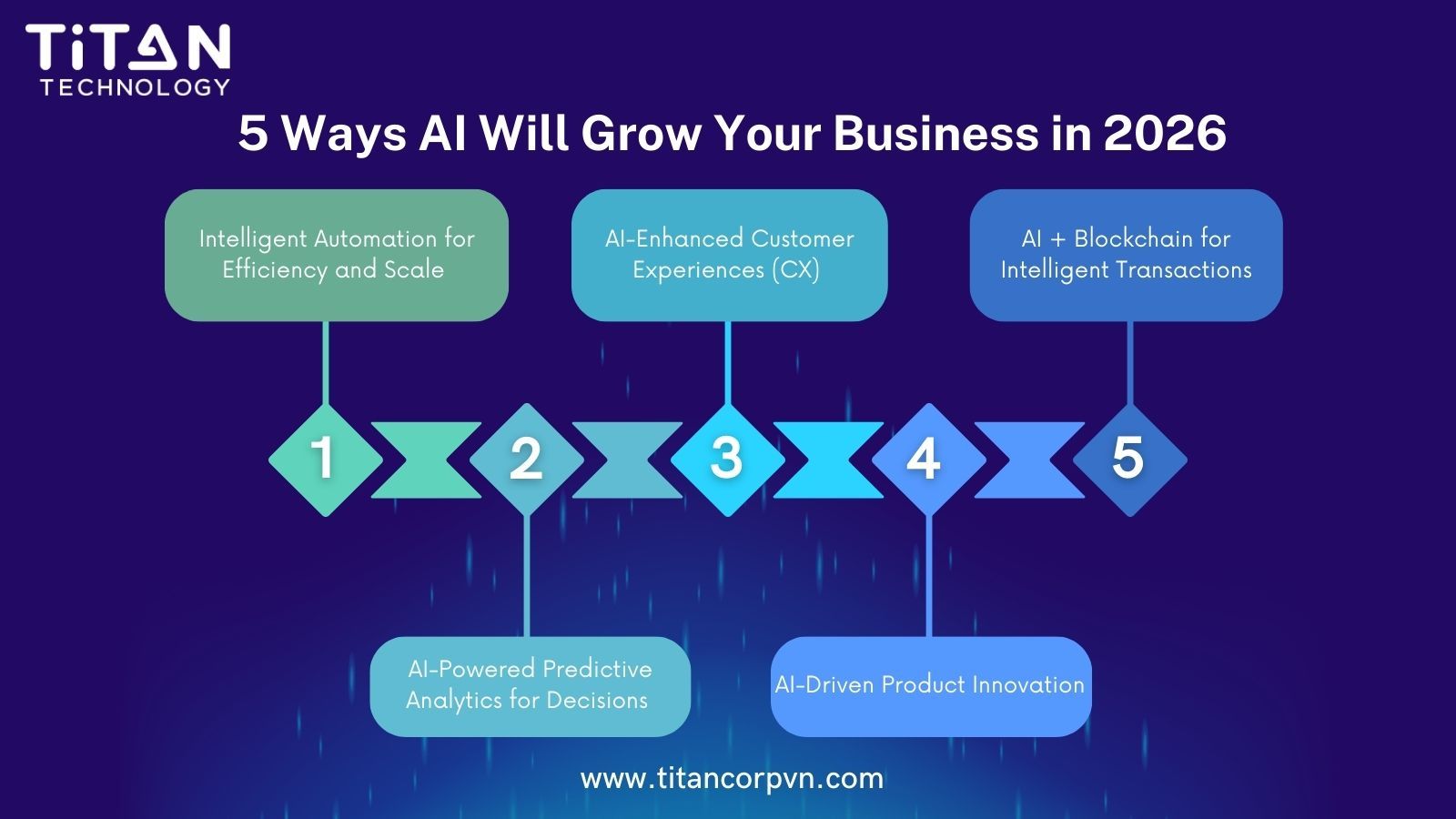
AI in 2026 is shifting from “supportive technology” to a core driver of enterprise growth, fueled by a global AI spending forecast of $300B+ (IDC).
Intelligent automation delivers 25–60% cost reduction and 50% faster turnaround by automating complex workflows — supported by real cases like DHL automating 95% invoice processing.
Predictive analytics transforms decision-making, helping enterprises forecast demand, reduce churn, and optimize operations — Carrefour achieved a 40% waste reduction using AI-driven forecasting.
AI-enhanced customer experiences increase loyalty and conversions, highlighted by Sephora’s AI virtual try-on generating 200M interactions and boosting conversions by 25%.
The combination of AI + Blockchain unlocks secure, intelligent transactions — enabling faster onboarding, stronger fraud detection, and trusted digital identity systems.
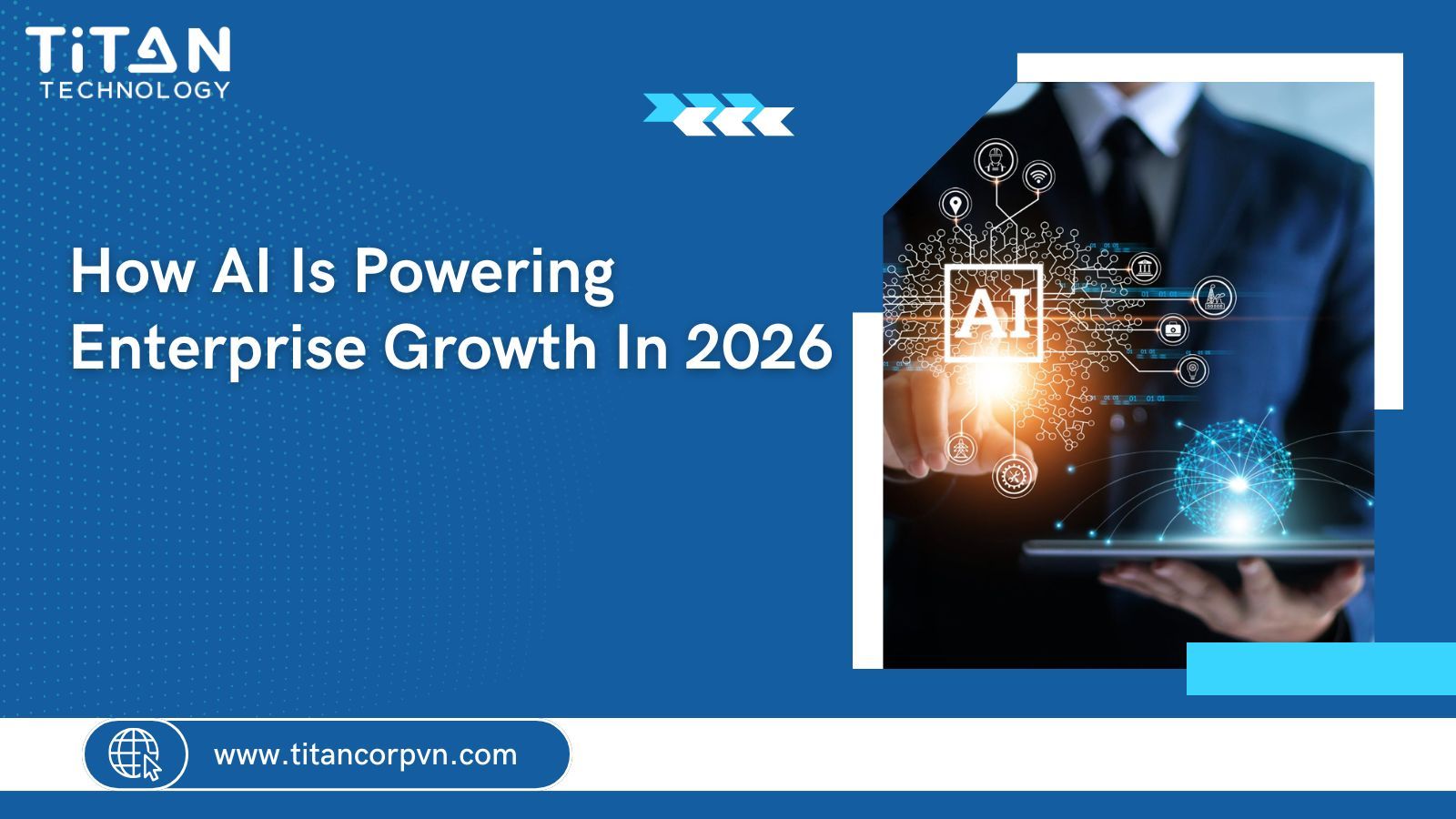
Artificial Intelligence isn’t just a buzzword anymore — it’s reshaping the way businesses grow. In 2026, AI is set to transform how enterprises operate, innovate, and stay competitive across every major industry.
From predictive analytics to intelligent automation, AI technologies are unlocking new efficiencies and revenue streams. According to IDC, global spending on AI systems is projected to exceed $300 billion this year, driven by enterprise leaders who view AI not just as a tool, but as a business enabler.
Still, one thing is clear: the companies seeing the highest ROI aren’t just adopting AI — they’re using it to solve real business problems.
In this article, we’ll explore five proven AI business solutions that are driving measurable outcomes—from cost savings and productivity gains to smarter customer experiences and product innovation. These are the strategies top companies are betting on in 2026 — and how technology partners like Titan Technology Corporation – a leading software outsourcing in Vietnam are helping make them real.
Use Case #1: Intelligent Automation for Cost-Efficiency and Scale
In today’s fast-moving business world, operational efficiency isn’t just a competitive edge — it’s essential for survival. That’s why more enterprises are turning to intelligent automation: AI-powered systems that streamline repetitive tasks, reduce manual workloads, and help businesses scale without adding headcount.
Why It Matters
Unlike traditional rule-based automation, intelligent automation adapts to real-world complexity. It understands context, manages exceptions, and improves over time. Whether it’s handling invoices, processing customer requests, or verifying documents, AI enables enterprises to work faster, more accurately, and at scale.
The Results Businesses Are Seeing
Companies that invest in intelligent automation often report:
25–60% cost reductions in operational processes
50% faster turnaround times in finance, HR, and support functions
Fewer compliance errors and better audit readiness
According to McKinsey, nearly one-third of activities in 60% of jobs can be automated using current technologies — especially in areas like logistics, manufacturing, and back-office operations
Real-World Impact
To tackle the complexity of global Duty VAT billing, DHL implemented an intelligent automation solution that integrated OCR, RPA, and ERP technologies. The result was a seamless, end-to-end workflow that processed over 50,000 invoices daily across 190+ countries. By automating more than 95% of manual tasks, the initiative freed up the equivalent of 350 full-time employees, reduced errors, and significantly improved compliance across regions — as outlined in DHL's digitalization case study.
How Titan Helps Drive Impact
At Titan, we work with clients across logistics, finance, and telecom to bring intelligent automation to life. Our approach combines AI engineering with deep industry knowledge. Typical projects include:
Smart document handling: Using AI to classify, validate, and extract data from documents
Test automation: Simulating user journeys to ensure product quality and stability
Workflow orchestration: Connecting automation pipelines with ERP and cloud systems
Reliability monitoring: Ensuring performance across distributed systems at scale
By focusing on real business outcomes — not just technical implementation — Titan helps enterprises move beyond one-off automation projects and toward a unified, enterprise-wide automation strategy.
Use Case #2: AI-Powered Predictive Analytics for Smarter Decisions
In a data-rich but decision-poor environment, enterprises are realizing that reacting too late often means missing out. That’s why many are turning to predictive analytics — AI-driven tools that turn historical and real-time data into forward-looking insights.
Why It Matters
Unlike traditional reporting, which looks at what already happened, predictive analytics answers a far more powerful question: what’s likely to happen next?
By analyzing patterns and anomalies in your data, AI can forecast customer churn, predict demand fluctuations, flag operational risks, and even guide investment decisions — enabling companies to act before problems arise or opportunities are lost.
The Results Businesses Are Seeing
Enterprises using predictive analytics effectively report:
Improved inventory planning and resource allocation
More accurate sales and revenue forecasting
Early identification of customer attrition
Faster, data-backed strategic decisions
According to PwC, data-driven organizations are three times more likely to report significant improvements in decision-making compared to those that aren’t leveraging analytics.
Real-World Impact
Carrefour, a global retail leader, implemented AI-driven predictive analytics to enhance its inventory management. By analyzing historical sales data, seasonal trends, and external factors like weather, the company was able to forecast demand more accurately — a success highlighted in this roundup of real-world predictive analytics examples. This approach led to a significant reduction in stockouts and overstock situations, improved customer satisfaction, and minimized waste. Notably, Carrefour Belgium reported a 40% decrease in food waste by 2022 compared to 2016.
How Titan Helps Drive Impact
At Titan, we help clients move from raw data to real decisions by building tailored predictive analytics pipelines. Our work spans:
Data preparation: Structuring historical and real-time data across systems
Model development: Applying machine learning to predict outcomes in sales, ops, and customer behavior
Visualization & integration: Connecting AI models to dashboards, BI tools, or real-time alerts
Continuous optimization: Retraining models to ensure accuracy as market conditions shift
The result? Clients gain not just insights, but actionable foresight — empowering smarter, faster, and more confident decision-making at every level of the business.
Use Case #3: AI-Enhanced Customer Experiences (CX)
In a world where customer expectations are rising faster than ever, businesses that personalize, predict, and respond in real time are winning loyalty. AI is now at the heart of that transformation — enabling smarter, faster, and more relevant customer experiences across every touchpoint.
Why It Matters
AI-powered experiences go beyond traditional service models. Through technologies like natural language processing, sentiment analysis, and recommendation engines, companies can anticipate customer needs, deliver 24/7 support, and personalize interactions at scale — all while reducing service costs.
From intelligent chatbots and virtual assistants to personalized content and dynamic product suggestions, AI is reshaping how customers engage with brands — and what they expect in return.
The Results Businesses Are Seeing
Companies adopting AI in their customer experience strategies report:
Higher customer satisfaction and loyalty
Reduced response times with 24/7 AI-powered support
Increased conversion rates through personalized recommendations
Better insights into customer behavior and preferences
According to Salesforce, it's important to note that 88% of customers consider the experience a company provides to be as important as its products or services.
Real-World Impact
Sephora, a leading global beauty retailer known for its innovation in digital retail, has integrated AI technologies to enhance its customer experience across digital platforms. By implementing tools like Virtual Artist, customers can virtually try on makeup products, leading to over 200 million virtual try-ons. Additionally, AI-powered chatbots handle 72% of routine customer inquiries, resulting in a 25% increase in sales conversions from sessions involving the chatbot — as detailed in this case study.
How Titan Helps Drive Impact
Titan works with clients to design and deploy customer experience systems powered by AI — improving both satisfaction and operational efficiency. Our work includes:
Conversational AI: Building chatbots and virtual agents that understand intent, context, and tone
Personalization engines: Recommending content, products, or actions based on behavioral data
Multilingual support: Training models to engage customers in multiple languages with natural fluency
CX analytics: Capturing and analyzing feedback to guide product and service enhancements
With Titan, companies go beyond simple automation — they build smarter, more responsive, and more human-like customer journeys that scale.
Use Case #4: AI-Driven Product Innovation
In today’s hyper-competitive markets, speed and relevance define product success. AI is enabling companies to develop smarter products faster — from identifying market gaps and testing ideas to predicting feature impact and optimizing user experience post-launch.
Why It Matters
Traditional product development cycles are long, costly, and risky. AI changes that by helping teams analyze user behavior, simulate new features, test variations in real time, and make iterative improvements based on predictive insights — without waiting for months of post-launch feedback.
Whether it's prioritizing a product roadmap or automating A/B testing, AI brings clarity and speed to innovation.
The Results Businesses Are Seeing
When AI is embedded into product development, companies often report:
Shorter time-to-market and reduced development costs
Higher user satisfaction through better personalization and usability
More successful feature adoption due to predictive rollouts
Fewer post-launch fixes and reduced churn
Recent research from Accenture shows that companies with AI-led processes achieve 2.5× higher revenue growth and 2.4× greater productivity than their peers — a clear signal that embedding AI into product innovation isn’t just smart, it’s a competitive advantage.
Real-World Impact
Amarra, a New Jersey-based distributor of special-occasion gowns, integrated AI tools into its operations to streamline product development and customer engagement. By employing AI-generated product descriptions, the company reduced content creation time by 60%. Additionally, an AI-powered inventory management system decreased overstocking by 40%, ensuring better alignment with customer demand. AI-driven chatbots now handle 70% of customer inquiries, allowing staff to focus on more complex issues. These innovations have significantly enhanced operational efficiency and customer satisfaction.
How Titan Helps Drive Impact
At Titan, we support clients across industries to embed AI into the product lifecycle — from ideation to iteration. Our capabilities include:
User behavior modeling: Understanding how users interact with digital products
Feature prediction models: Prioritizing roadmap items based on impact forecasts
Experimentation platforms: Automating testing, learning, and refinement loops
AI-powered feedback analysis: Identifying pain points and opportunities from customer input
We help product teams move faster, build smarter, and deliver solutions that truly resonate with users — backed by data, not guesswork.
Use Case #5: Combining AI + Blockchain for Secure, Intelligent Transactions
As enterprises handle more digital transactions, from payments to data exchanges, the need for both intelligence and trust has never been greater. The convergence of AI and blockchain offers a powerful solution: smarter systems that are not only fast and adaptive, but also transparent, traceable, and tamper-proof.
Why It Matters
Blockchain provides immutable records and decentralized trust, while AI introduces intelligence — enabling real-time decisions, anomaly detection, and automated workflows. When integrated, these technologies allow businesses to process high-value or high-risk transactions with speed, security, and confidence.
Use cases range from fraud prevention and smart contracts to digital identity verification and compliance monitoring — particularly valuable in industries like finance, supply chain, and insurance.
The Results Businesses Are Seeing
Companies combining AI and blockchain technologies have reported:
Faster transaction processing with greater reliability
Enhanced fraud detection using behavioral and contextual analytics
Stronger audit trails and regulatory compliance
More secure digital identity management
As data volumes grow, AI ensures systems stay responsive — and blockchain ensures they stay trusted.
Real-World Impact
A global financial services provider faced delays in onboarding due to fragmented identity checks and manual compliance processes. By combining AI-powered document verification with a blockchain-based digital identity ledger, the company automated Know Your Customer (KYC) validation across its network. The new system reduced onboarding time by over 50%, improved fraud detection accuracy, and ensured a secure, auditable trail for every identity.
How Titan Helps Drive Impact
Titan helps enterprises build secure, AI-powered transaction systems where speed and trust are critical. Our expertise includes:
AI-driven risk scoring: Detecting fraud and anomalies in real time
Smart contract automation: Enabling conditional, self-executing transactions
Digital identity systems: Verifying users and assets across blockchain networks
Audit and compliance tools: Building transparent, traceable transaction histories
Whether you're securing financial operations, digitizing supply chains, or enabling data-sharing ecosystems, Titan helps turn emerging tech into enterprise-grade trust infrastructure.
Conclusion – AI as a Core Driver of Business Impact
AI is no longer experimental — it's operational, measurable, and transformative. The organizations leading in 2026 aren’t just adopting AI; they’re embedding it across their operations to drive efficiency, resilience, and growth.
From automating at scale and predicting business outcomes, to personalizing customer journeys, accelerating product innovation, and securing digital transactions — AI is evolving from a tool into a foundational capability.
But to move beyond pilots and see lasting impact, companies need more than just AI platforms. They need the right strategy, domain expertise, and an execution partner who can turn ambition into outcomes.
Ready to turn AI into a business advantage? Connect with Titan’s advisory team and let’s build a roadmap tailored to your goals.