

Summary
Analytics adoption is high, but data trust remains low. Despite widespread dashboards and reports, leaders still question which numbers are reliable due to inconsistent metrics across teams and systems.
The core issue is weak data management, not analytics tools. When data is analyzed before being properly managed, analytics amplifies inconsistency instead of delivering clarity.
Many organizations confuse data analytics with data management. Data management creates trust and stability, while analytics generates insight. Blurring these roles stalls analytics maturity, regardless of tool investment.
Modern data platforms unite both disciplines. By integrating data management and analytics on a shared foundation, organizations achieve consistent metrics, scalable insights, and faster, more confident decision-making.

Most organizations today have invested in data analytics. Dashboards are common. Reports are easy to generate. In fact, adoption of big data analytics is expected to reach 75% globally between 2023 and 2027, making analytics a standard capability rather than a competitive advantage.
Yet many leadership meetings still start with the same question: which numbers can we trust?
Metrics often look polished, but they do not always align. The same performance indicator can tell different stories depending on the team, the system, or the report being reviewed. When this happens, analytics stops supporting decisions and starts slowing them down.
This problem rarely comes from analytics tools themselves. It comes from a deeper issue. Data is being analyzed before it is properly managed. When data management is weak, analytics amplifies inconsistency instead of delivering clarity. Trusted insights come from strong data foundations, not better dashboards alone.
Analytics Maturity Is Not Keeping Pace with Analytics Investment
Many organizations believe they are doing analytics simply because they have BI tools, dashboards, and regular reports. But maturity is not measured by how many reports exist. It is measured by whether analytics changes how decisions are made.
Gartner has highlighted a hard reality. Most organizations have not reached a transformational level of data and analytics maturity. This helps explain why two companies can use similar analytics tools and still see very different outcomes.
In less mature organizations, analytics often lives in isolated pockets. Each department defines metrics differently. Data is pulled quickly to answer immediate questions but not governed well enough to support confident decisions. Dashboards may look polished, yet leaders still ask which numbers they can trust.
What we see in practice is that maturity gaps rarely come from a lack of analytics ambition. They come from unresolved data foundations that never scaled beyond the first few use cases.
This is where confusion between data management and data analytics starts to limit progress. One discipline creates reliable foundations. The other builds insights on top of them. Without the foundation, analytics only makes inconsistencies more visible.
Why Businesses Often Confuse Data Management with Data Analytics
In many organizations, analytics is the most visible part of the data landscape. Dashboards are what executives see. Reports are what teams share. As a result, analytics often becomes shorthand for everything related to data.
Forrester has observed that many enterprises rely on multiple BI and analytics tools to serve different teams and use cases. While this flexibility helps teams move faster, it also creates a fragmented environment where data definitions, metrics, and assumptions vary from one tool to another. Over time, analytics begins to reflect these inconsistencies rather than resolve them.
This is where the confusion takes root. Organizations attempt to fix trust and alignment issues by adding more analytics capabilities, believing better dashboards will lead to better decisions. In reality, the underlying problem usually sits in data management. Without clear ownership, consistent definitions, and governance, analytics only amplifies fragmentation.
Data management and data analytics serve different purposes. One creates stability and trust. The other creates insight and momentum. When these roles are blurred, analytics maturity stalls, no matter how many tools are deployed.
Data Management vs Data Analytics: A Clear Business Comparison
The easiest way to separate data management from data analytics is to look at the role each one plays in real business decisions. While they are closely connected, they solve very different problems.
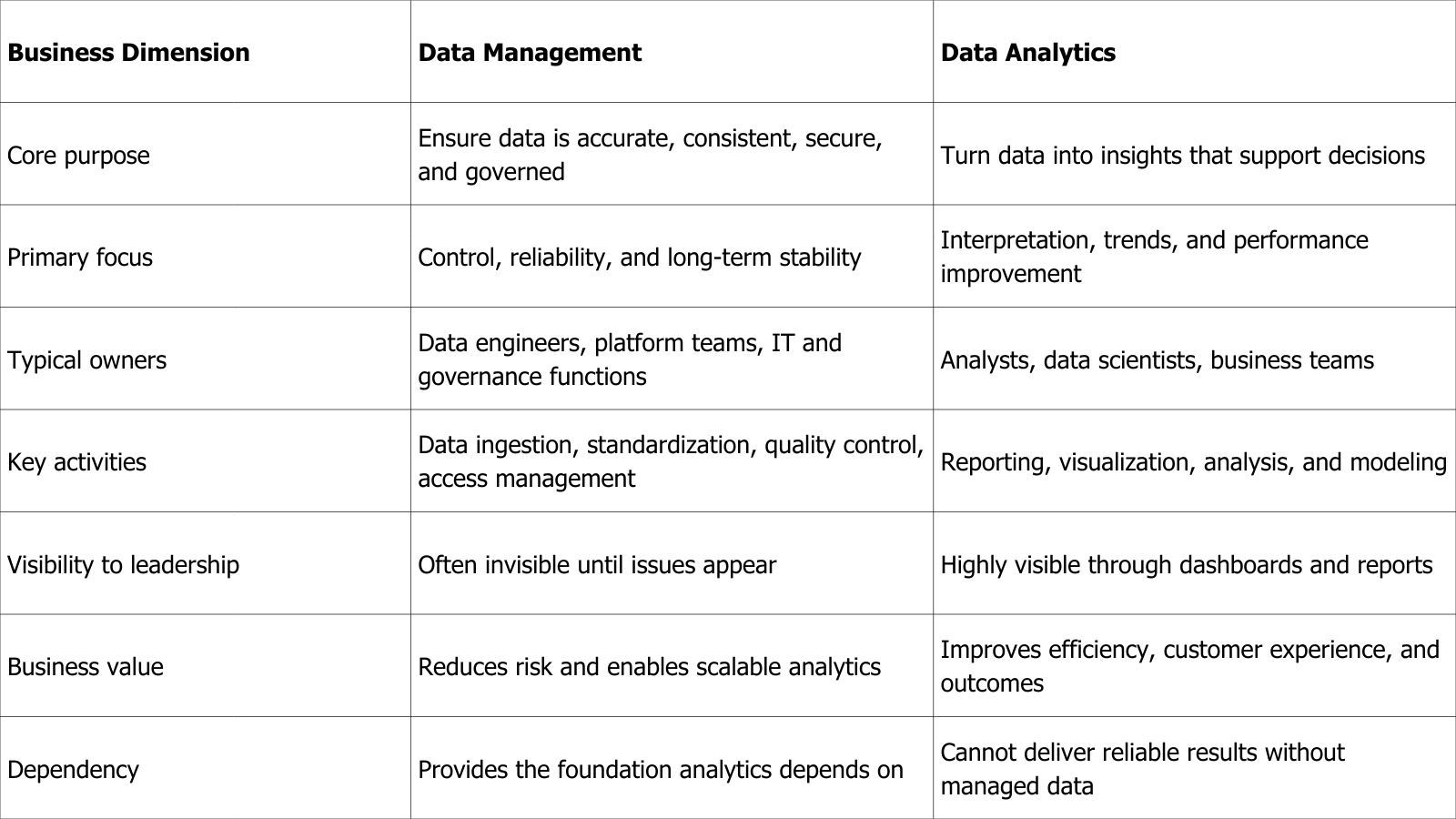
When organizations treat these capabilities as interchangeable, they tend to invest heavily in analytics while underestimating the work required to manage data properly. The result is familiar. Dashboards exist, but trust does not.
Understanding this distinction is critical before moving deeper into platform design. Data management creates the conditions for trust. Data analytics delivers value on top of that trust.
What Is Data Management? The Invisible Layer That Determines Trust
Data management rarely gets the same attention as analytics, but it quietly determines whether analytics can be trusted at all. At its core, data management is about control and consistency. It defines where data comes from, what it means, who owns it, and how it can be used safely across the organization.
In practice, data management covers the full lifecycle of data. This includes how data is collected from different systems, how it is standardized, how quality issues are handled, and how access is governed. When these foundations are clear, teams spend less time debating numbers and more time acting on them.
When data management is weak, problems surface quickly. The same metric may be calculated differently across teams. Reports may conflict without a clear source of truth. Over time, confidence erodes, even if analytics tools are sophisticated.
Strong data management does not create insights by itself. What it creates is trust. And without trust, analytics cannot scale beyond isolated use cases or individual teams.
What Is Data Analytics? Turning Data into Decisions
Data analytics is where data starts to matter to the business. It is not about charts or reports alone. It is about using data to answer real questions and guide real decisions.
When data is well managed, analytics helps teams understand what is happening, why it is happening, and what they should do next. Leaders use analytics to improve operations, spot risks earlier, understand customer behavior, and plan with more confidence. In these situations, analytics becomes part of everyday decision making, not a separate technical exercise.
Problems arise when analytics is expected to compensate for weak data foundations. Analysts spend time cleaning data instead of analyzing it. Business users question results instead of acting on them. Over time, analytics slows down rather than accelerates decisions.
Data analytics delivers value only when it builds on reliable, consistent data. It does not fix data issues. It exposes them. When analytics is supported by strong data management, insights scale across teams and decisions move faster with less debate.
Why Analytics Initiatives Break Down Without Strong Data Management
Many analytics initiatives fail for reasons that sound simple but are hard to fix. Teams buy tools, build dashboards, and ship reports, yet decision making does not improve in a consistent way.
A common failure pattern is inconsistency. The same metric shows different values depending on the system or team that produced it. People spend more time reconciling numbers than acting on them. Over time, dashboards start to feel like noise.
Scale is another issue. A good analysis might work inside one team, then break when other departments try to reuse it. Without clear ownership, shared definitions, and governance, insights stay local and fragile.
The survey results from Wavestone’s 2024 Data and AI Leadership Executive Survey show that organizations are pursuing measurable value from data and analytics, and many report success. In the same report, 87.0% said they are delivering measurable business value from data and analytics investments. What separates repeatable value from one off win is usually not the dashboard layer. It is the data foundation underneath it.
How Modern Data Platforms Bring Data Management and Analytics Together
When analytics and data management are treated as separate initiatives, friction is almost guaranteed. Modern data platforms exist to remove that separation.
A modern data platform is designed to manage data and analyze it as part of the same system. Data ingestion, storage, processing, governance, and analytics are connected by design, not stitched together later. This changes how teams work with data day to day.
With a shared platform, data definitions are consistent across teams. Governance is applied once and reused everywhere. Analysts spend less time fixing data and more time exploring it. Business users see the same numbers, no matter which tool they use to access them.
Most importantly, analytics stops being fragile. Insights can scale across departments because they are built on managed, trusted data. Instead of asking which dashboard is correct, leaders can focus on what the data is telling them and what action to take next.
This is why organizations that invest in data platforms tend to see analytics mature faster. They are not choosing between data management and analytics. They are designing a foundation where both can succeed together.
When Businesses Should Move Beyond Analytics Tools to a Data Platform
Many organizations start their analytics journey with tools. That approach makes sense at first. A BI platform can answer urgent questions and deliver quick wins. Problems appear when the business grows but the data foundation does not.
One clear signal is when teams no longer agree on the numbers. Different reports show different results for the same metric, and meetings turn into debates about whose dashboard is correct. Another signal is speed. Simple questions take days to answer because data must be pulled, cleaned, and reconciled every time. A third signal is scale. Analytics works for one team but breaks when other departments try to reuse it.
At this point, adding more tools rarely helps. It usually adds complexity. A data platform becomes necessary when the business needs shared definitions, consistent governance, and analytics that can scale across teams.
Moving to a data platform is not about replacing analytics tools. It is about giving those tools a foundation they can rely on. When data is managed and analytics is built on top of it, decisions become faster, clearer, and easier to trust.
Conclusion
Data management and data analytics are often discussed as separate initiatives, but in practice, they succeed or fail together. Analytics creates value only when it is built on data that is consistent, governed, and trusted. Data management creates that trust, but only analytics can turn it into action.
Organizations that struggle with analytics rarely lack tools. What they lack is a foundation that allows insights to scale beyond individual teams. When data is fragmented, analytics amplifies confusion. When data is managed well, analytics becomes a natural part of decision making.
Modern data platforms exist to bring these capabilities together. They remove the gap between managing data and using it. Instead of debating numbers, teams focus on outcomes. Instead of fixing data repeatedly, they move faster with confidence.
How Titan can help
Titan Technology works with organizations to design and build modern data platforms that align data management and analytics from the start. From data ingestion and governance to analytics and AI readiness, we focus on creating foundations that scale with the business, not just dashboards that look good.
If your analytics investments are growing but trust in data is not, it may be time to rethink the foundation underneath. A well-designed data platform is often the turning point