

Summary
AI in customer service is no longer a support tool, but an operating model decision that determines how well service scales under growing demand.
Traditional service models break at scale because costs rise faster than capacity, workflows fragment, and quality becomes inconsistent across channels.
AI creates value when it redesigns execution, absorbing high-volume, low-variability work while preserving human judgment for complex cases.
Moving from chatbots to AI agents enables real impact, as automation shifts from conversation to controlled execution within core workflows.
Leaders who focus on structure, ownership, and governance can scale customer service sustainably without sacrificing quality, control, or consistency.
The real problem with customer service today isn’t that teams aren’t working hard enough. It’s that the operating model behind it can no longer keep up as demand grows faster than capacity.
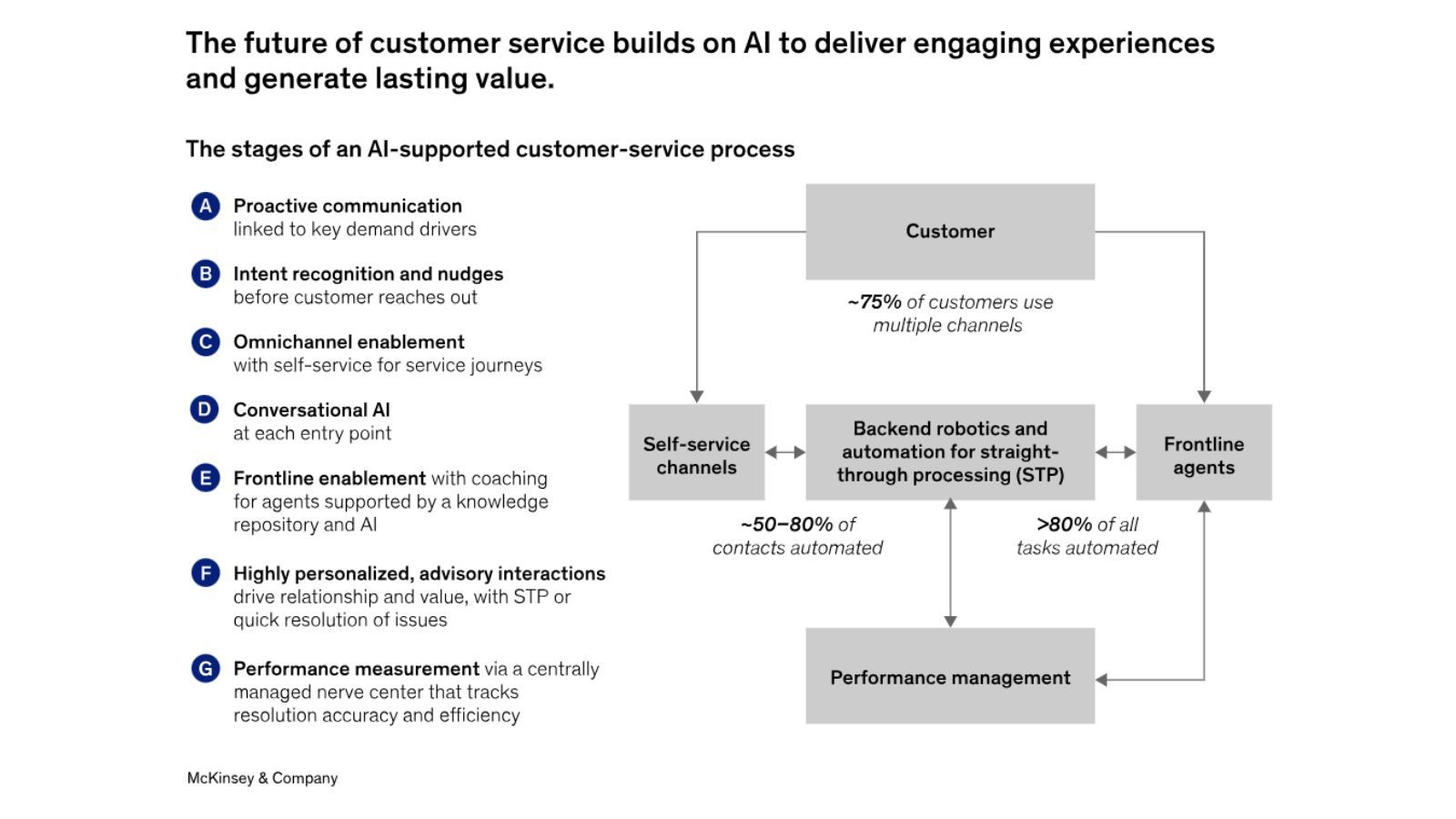
As customer journeys become more fragmented, service transitions from simple conversations into coordination-heavy operations. According to McKinsey, an estimated 75 percent of customers use multiple channels in their ongoing experience, significantly increasing the complexity behind every interaction.
This pressure is reshaping how customer service must be designed from the very first point of contact. Gartner predicts that by 2028, at least 70% of customers will use a conversational AI interface to start their customer service journey, signaling a structural shift in how scale is built.
For business leaders, the choice has become unavoidable. Adding headcount drives costs up, while cutting budgets risks eroding service quality. That is why AI in customer service is no longer a technology experiment, but a strategic operations decision about how to scale support without losing quality, consistency, or control.
Why Traditional Customer Service Models Break at Scale
Traditional customer service models were designed for stability. With fewer channels and predictable demand, organizations could manage growth by adding agents and standardizing workflows. That logic no longer holds in today’s operating environment.
As service volumes grow, interactions become more fragmented and less linear. A single request may be handled across multiple channels, including chat, email, and voice, before being resolved. As shown in Zendesk’s analysis of customer service operations, rising interaction complexity drives higher average handling times and escalation rates when workflows are not redesigned. Simple requests often require the same effort as complex issues.
The most common response is to add capacity. More agents temporarily reduce backlogs, but costs rise faster than throughput. Recruiting, onboarding, and coordination overhead limit real productivity gains. Over time, organizations spend more just to maintain the same service levels.
Cost pressure is compounded by how work is distributed. IBM reports that routine inquiries such as order tracking or password resets can account for up to 80% of support capacity. When skilled agents spend most of their time on repetitive tasks, complex issues slow down, and service quality becomes inconsistent.
Many teams attempt to patch these problems with standalone tools. Instead of simplifying work, fragmented systems force agents to switch contexts constantly. As a result, average response times still hover around 24 hours for many businesses, a benchmark that increasingly fails to meet customer expectations (AgencyAnalytics).
At scale, these dynamics converge. Costs rise faster than capacity, quality becomes uneven, and service organizations spend more effort managing workflows than resolving customer needs. Traditional customer service models break down not because teams fall short, but because the underlying structure cannot absorb sustained complexity.
Customer Service Has Become a Core Operations Issue
Customer service can no longer sit on the edge of the organization. As service complexity grows, it increasingly influences how businesses control costs, retain customers, and scale sustainably. What was once viewed as a support function is now shaping decisions at the leadership level.
Direct Impact on Business Drivers
Customer service is often one of the largest and most flexible cost components in an organization. As volumes rise, costs tend to increase in direct proportion to headcount. This dynamic makes service performance a critical factor in margin control, especially during periods of growth.
Beyond cost, service quality plays a decisive role in retention and trust. In markets where products and pricing are easy to replicate, consistent service becomes one of the few remaining differentiators. When service models fail to scale, inconsistency spreads across channels, directly weakening customer loyalty and brand confidence.
The Strategic Intersection
Today, customer service sits at the intersection of three core functions. Operations define how requests flow and how issues are resolved. Technology determines how data is accessed and how systems interact with each other. Finance evaluates whether service investments deliver sustainable returns as volumes grow.
When these functions operate in silos, service performance degrades quickly. When they are aligned, customer service becomes a lever for both efficiency and experience rather than a source of friction.
The Executive Insight: Customer service is no longer a support function. It is an operational system that determines how well a business can grow without losing control of cost or quality.
Redesigning the Customer Service Operating Model With AI
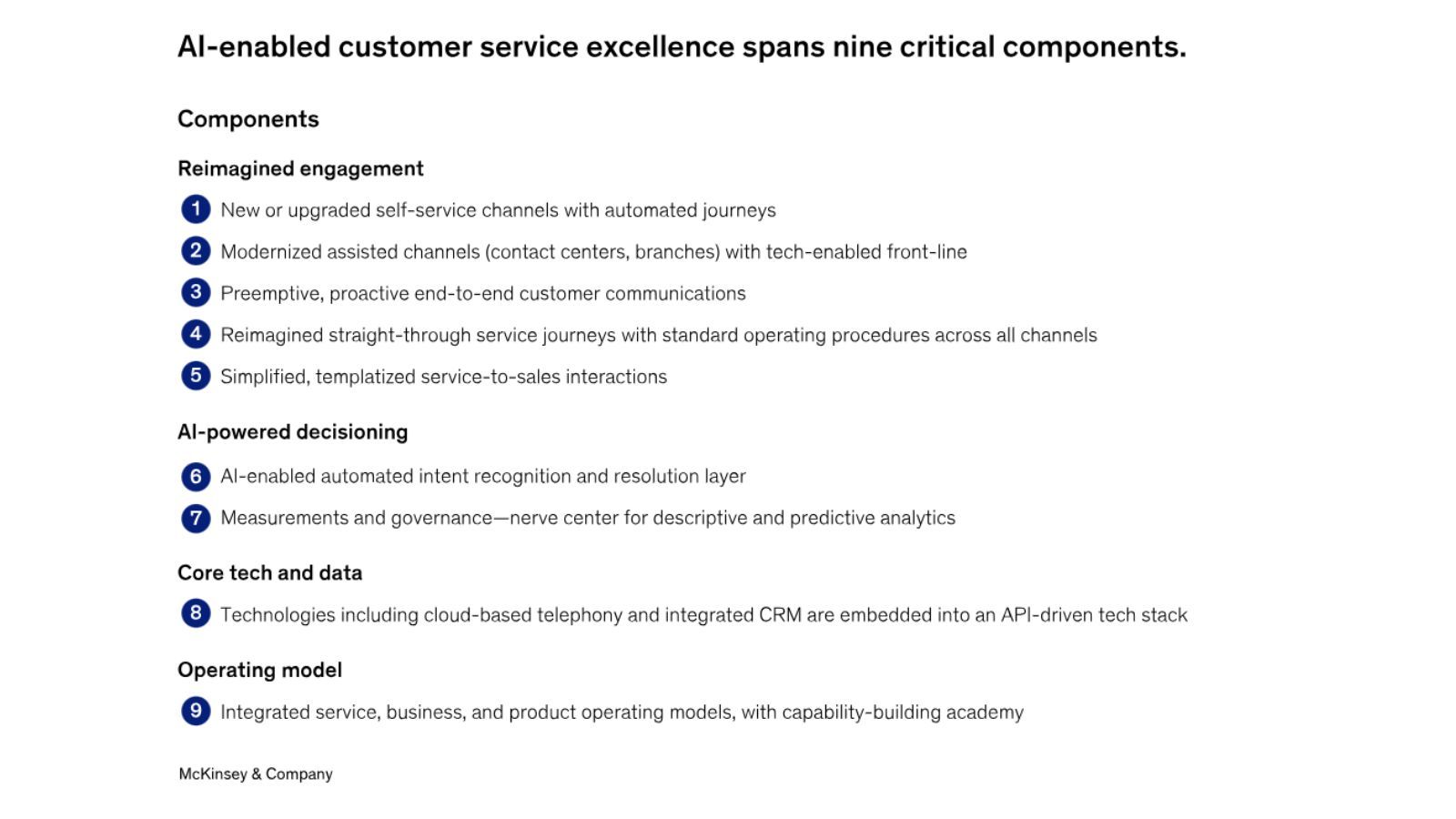
Scaling customer service without losing quality cannot be achieved by layering automation onto legacy workflows. It requires a redesign of how service demand enters the organization, how work is coordinated, and how outcomes are governed at scale.
In a modern operating model, AI is not confined to a single interface. It functions as the connective layer that aligns self-service, backend automation, frontline teams, and performance management into a single system.
From Fragmented Interactions to Coordinated Execution
Traditional customer service treats each interaction as an isolated event. Requests are received, routed manually, and resolved within disconnected tools. As volumes increase, this approach creates duplication, inconsistent decisions, and unnecessary handoffs.
An AI-supported operating model shifts the focus from individual interactions to coordinated execution. Demand is interpreted in context, considering intent, urgency, and history rather than the channel alone. Routine requests are addressed early through self-service and streamlined processing, while complex issues are routed to frontline teams with the necessary context already in place.
The result is not simply faster responses, but a system that applies effort proportionally. Human judgment is reserved for cases where it adds the most value, instead of being consumed by repetitive work.
Automation That Strengthens Control, Not Weakens It
In a redesigned model, automation is applied selectively. Backend processes handle predictable tasks with consistency, while frontline agents are supported with real-time insights, recommendations, and decision support. Accountability remains clear, even as volume increases.
This structure reduces variability across channels and regions. Instead of relying on individual experience or manual workarounds, decisions are guided by shared logic and continuously refined through performance feedback.
Performance Management as Part of the System
A key shift in this operating model is how performance is managed. Measurement moves beyond isolated channel metrics to an end-to-end view of resolution quality, efficiency, and accuracy. Bottlenecks become visible earlier, and improvement efforts focus on process design rather than individual effort.
AI enables this by learning from outcomes and adjusting prioritization, routing, and knowledge usage as demand patterns evolve. This feedback loop enables service organizations to scale without compromising consistency or control.
A Structural Redesign, Not a Feature Upgrade
The organizations that succeed with AI in customer service do not treat it as a feature upgrade. They redesign how service demand flows through the business and how decisions are made at scale.
This structural shift aligns cost efficiency with service quality instead of forcing a trade-off between them. It creates the foundation for sustainable growth, where customer service becomes a coordinated operating system rather than a collection of disconnected tools.
The Economics of AI in Customer Service
For CFOs and COOs, the case for AI in customer service goes beyond headcount reduction. The primary economic value lies in changing the cost dynamics of service operations while enabling organizations to scale without proportional increases in labor.
ROI Beyond Cost Reduction
The financial impact of an AI integrated service model appears across several dimensions. The most immediate is cost per interaction. Research from Juniper Research shows that businesses can save approximately $0.50 to $0.70 per interaction when routine requests are handled through automated systems rather than human agents. At scale, even small per interaction savings accumulate into material financial impact.
Another critical dimension is capacity recovery. Industry research consistently shows that routine inquiries such as order tracking, password resets, or balance checks account for the majority of service volume. When this workload is absorbed by automation, organizations recover thousands of productive hours without expanding payroll. Human teams can then focus on complex cases, retention efforts, and high value interactions that directly influence business outcomes.
Time efficiency further reinforces the economic case. Studies indicate that automated handling can save around four minutes of agent time per query. Faster resolution reduces backlog pressure, stabilizes service levels during demand spikes, and lowers the operational friction that typically accompanies growth.
Industry Level Economic Impact
In banking, AI absorbs high volumes of predictable requests such as card actions or balance inquiries, reducing the need for additional call center capacity during peak periods. In healthcare, AI supported scheduling and triage help lower administrative overhead while ensuring that urgent cases receive timely attention. In both sectors, the financial benefit comes from operational stability rather than short term cost cutting.
Viewed through this lens, AI in customer service is not a tactical efficiency tool. It is a structural lever that allows organizations to grow service capacity while keeping costs and performance under control.
From Chatbots to AI Agents: Why Execution Matters
To scale customer service without sacrificing quality, leaders must distinguish between surface level automation and operational execution. Many organizations begin with chatbots, but meaningful impact depends on how far automation extends into real workflows.
The Limits of Conversation
Traditional chatbots are primarily designed to communicate. They follow predefined scripts and decision paths, making them effective for answering basic questions. When requests require judgment, system access, or multi step resolution, these tools often reach their limit and rely on human escalation. At scale, this creates friction rather than removing it.
Execution as an Operating Capability
AI agents represent a different approach. Rather than stopping at responses, they are designed to execute defined tasks within controlled boundaries. Connected to core systems such as customer records, service platforms, and internal workflows, AI agents can complete routine actions while preserving context and consistency.
This shift matters because it removes work from the system, not just conversations. When execution is automated responsibly, entire classes of repetitive tasks no longer enter human queues, allowing teams to focus on cases that require judgment and oversight.
From Suggestions to Structured Action
The strategic value of AI emerges when it moves beyond recommendations and becomes part of the operating flow. Instead of instructing customers on what to do next, execution capable systems can carry out approved actions and confirm outcomes in real time, under predefined rules.
For leadership, the priority is not deploying tools that can communicate more naturally. It is designing an execution model where automation operates alongside human teams with clear governance, accountability, and escalation paths.
Execution Is What Separates Experiments From Impact
The transition from chatbots to AI agents marks a shift from experimentation to operational impact. Organizations that stop at conversational automation see incremental gains. Those that design for execution build service operations that can scale predictably without eroding quality or control.
Why Many AI Customer Service Initiatives Fail to Scale
Despite the growing interest in AI, many customer service initiatives fail to deliver sustained value. In most cases, the issue is not the technology's performance, but rather how AI is introduced into the organization.
A common mistake is treating AI as a quick fix rather than a structural change. When automation is applied to inefficient or fragmented workflows, AI simply accelerates existing problems. The process remains broken but now operates at a higher speed and scale.
Another frequent barrier is the use of standalone tools. Many organizations deploy AI solutions that operate independently of their core systems and data. This creates new silos and forces human teams to manually reconcile information across platforms. Instead of reducing effort, automation adds another layer of coordination.
Lack of ownership further limits impact. When responsibility for AI is ambiguously shared between operations and technology teams, initiatives often lack strategic direction. Without clear accountability for quality, decision boundaries, and escalation rules, trust in the system erodes, and costs increase through constant intervention.
These failures share a common root. AI initiatives stall not because the tools lack capability, but because the operating model has not been redesigned to support execution at scale.
What Business Leaders Should Focus On Before Scaling AI
Before expanding AI across customer service, leadership teams need to shift the conversation away from tools and toward operating discipline. The following priorities determine whether AI becomes a scalable capability or remains a series of pilots.
Start With the Operating Model, Not the Technology
AI delivers value only when workflows are stable and clearly defined. Leaders should focus first on simplifying service flows, clarifying decision paths, and eliminating unnecessary handoffs. Automating complexity rarely produces sustainable results.
Define Ownership and Decision Rights
Successful AI initiatives have clear accountability. One function must own service outcomes, quality standards, and escalation rules, even if technology teams support implementation. Without ownership, AI adoption tends to fragment quickly.
Prioritize High Volume, Low Variability Work
Not every interaction should be automated. Leaders should focus AI on predictable, repeatable requests that create operational drag at scale. These use cases generate early impact while reducing risk.
Measure Outcomes, Not Activity
Metrics should reflect business outcomes rather than surface-level efficiency. Cost per interaction, resolution quality, and capacity stability matter more than deflection rates or conversation counts. What gets measured determines how AI evolves.
Build Governance Before Expanding Execution
As AI moves into execution, governance must be in place. Clear permission boundaries, auditability, and human override paths protect both customers and the organization. Scaling without control creates risk rather than value.
Executive Takeaway:
AI in customer service is not a decision to deploy. It is an operating model decision. Leaders who focus on structure, ownership, and outcomes create systems that scale predictably. Those who focus on tools alone remain stuck in experimentation.
Conclusion
Scaling customer service in the age of AI is not about finding a better chatbot. It is a strategic decision to redesign how the organization operates under growing demand and increasing complexity.
AI is not a shortcut to instant results. Its real value lies in how it amplifies human capability. By absorbing routine work, AI allows teams to focus on judgment, empathy, and complex problem solving. These are the elements that define service quality at scale.
Sustainable results come from structural choices. Organizations that succeed redesign workflows around resolution rather than activity. They maintain discipline around data, governance, and accountability. Most importantly, leadership treats AI as a long-term operational capability, not a temporary IT initiative.
At Titan Technology, we help business leaders redesign customer service as an operating system, not just a digital touchpoint. Our focus is aligning AI with workflows, data, and governance so service operations can scale with consistency, control, and measurable impact.
Contact us to discuss your current service operating model and identify where AI can create durable value without compromising quality. A focused conversation can help clarify where scale breaks today and what it will take to fix it.