

As enterprise AI systems transition from experimentation to core business workflows, organizations are facing a new class of risk. The challenge is no longer whether AI can produce useful results, but whether those results can be trusted, explained, and governed once they reach production.
In many enterprise environments, AI decisions influence financial analysis, operational planning, customer interactions, and regulatory reporting. Yet the systems producing those decisions often operate as black boxes. Responses cannot be reliably reproduced. Memory and inferred knowledge evolve without visibility. Data, context, and intermediate signals may cross boundaries that governance teams cannot fully observe or verify.
This lack of control creates friction long before formal audits or compliance reviews begin. Security, risk, and governance teams struggle to answer basic questions about how decisions were made, what information was used, and whether the system behaved within approved constraints. As a result, organizations hesitate to expand AI usage beyond narrow pilots, even when the technology itself performs well.
This case study examines how AYITA was designed to address this gap by introducing control, traceability, and reproducibility as first-class properties of enterprise AI systems. Rather than focusing on faster deployment or broader capabilities, AYITA enables organizations to operate AI in a way that can be reviewed, audited, and trusted within existing enterprise boundaries.
The Challenge
As AI systems are embedded deeper into enterprise workflows, organizations encounter a set of challenges that traditional governance models were never designed to handle. These challenges do not stem from model accuracy or infrastructure maturity. They arise from a fundamental lack of control over how AI systems behave once deployed.
1. AI decisions were not reproducible
The same input could produce different outputs at different times, even under similar conditions. Without deterministic behavior, teams could not replay decisions, validate outcomes, or investigate incidents with confidence. This made post-incident analysis difficult and weakened trust in AI-assisted decisions.
2. Memory and knowledge operated as a black box
AI systems accumulated context, preferences, and inferred knowledge over time, but organizations had limited visibility into what was retained, reused, or forgotten. There was no reliable way to inspect or correct what the system believed, nor to ensure that outdated or incorrect knowledge was removed.
3. Decisions left no audit-grade trail
While logs existed at the infrastructure level, they did not capture decision lineage in a way that governance teams could review. Inputs, policies, intermediate steps, and final outputs were not consistently linked. As a result, explaining how or why a decision was made required manual reconstruction and subjective interpretation.
4. Data and inference crossed boundaries invisibly
Context embeddings, inferred signals, and intermediate data often moved beyond approved perimeters without explicit controls. Even when raw data remained inside the environment, derived knowledge and inference paths were difficult to track. This created uncertainty around data residency, access boundaries, and compliance obligations.
Together, these issues made enterprise AI difficult to govern at scale. Security and risk teams lacked the evidence needed to assess behavior. Compliance teams had nothing concrete to audit. Business stakeholders hesitated to rely on AI outputs that could not be explained or verified. As a result, AI initiatives stalled or remained tightly constrained, despite strong technical performance.
The Objective
Making enterprise AI controllable, auditable, and predictable
The objective was not to introduce new AI capabilities or improve model performance. The goal was to make AI systems behave in a way that enterprise teams could reliably control, explain, and govern once deployed into real workflows.
To move beyond constrained pilots, the organization needed an approach that treated control as a core system property rather than an afterthought. AI decisions had to be reproducible. Memory and knowledge had to be inspectable and correctable. Every execution needed to leave a trace that governance and audit teams could independently verify.
Rather than relying on policy documents or manual reviews, the objective was to embed governance directly into how AI systems operate at runtime. Control had to be enforced continuously, not inferred after the fact.
Key objectives included:
Ensuring deterministic behavior so the same inputs reliably produced the same outputs
Making AI memory and retained knowledge visible, editable, and accountable
Capturing complete decision lineage linking inputs, policies, decisions, and outcomes
Preventing data, context, and inference from crossing approved boundaries
Producing concrete evidence that security, risk, and compliance teams could audit without manual reconstruction
By achieving these objectives, the organization aimed to establish a foundation where AI systems could be trusted not because they performed well, but because their behavior could be reviewed, verified, and controlled within existing enterprise governance frameworks.
The Solution
AYITA was designed as an enterprise AI control layer that sits between policy and execution. Instead of treating governance as documentation or post hoc review, AYITA embeds control, traceability, and boundary enforcement directly into how AI systems operate at runtime.
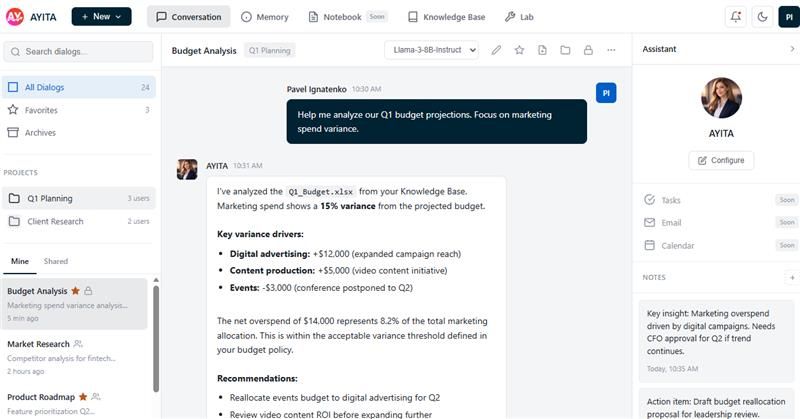
The solution focuses on making every AI action observable, reproducible, and reviewable without disrupting existing workflows or requiring changes to core models.
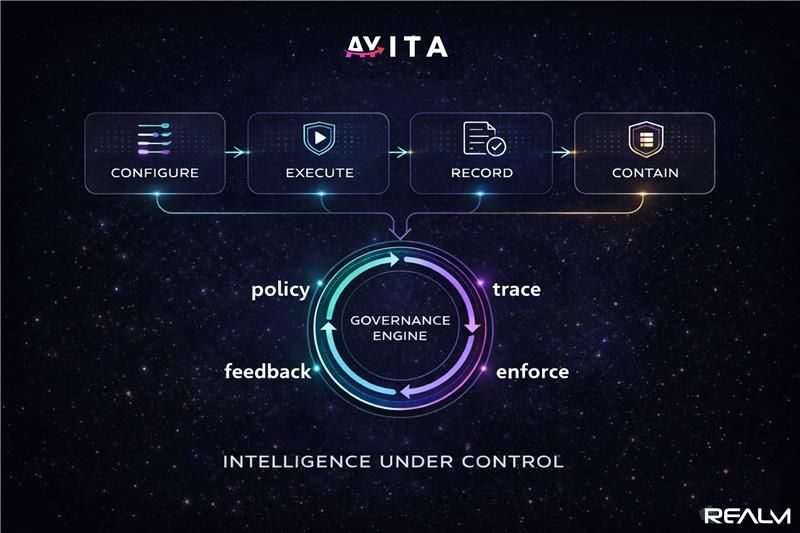
1. Policy driven execution
All AI interactions are executed against explicit policies that define what the system is allowed to access, retain, infer, and produce. These policies are not static guidelines. They are enforced at runtime, ensuring that AI behavior remains within approved constraints throughout execution.
2. Deterministic decision handling
AYITA ensures that AI decisions can be replayed and verified. Given the same inputs, context, and policy conditions, the system produces consistent outcomes. This allows teams to reproduce decisions, investigate incidents, and validate behavior without ambiguity.
3. Controlled memory and knowledge management
AI memory and retained knowledge are treated as governed assets. AYITA makes it possible to inspect what the system knows, understand how that knowledge influences decisions, and correct or remove information when required. Memory is no longer opaque or self-evolving beyond oversight.
4. End to end traceability
Every AI execution produces a complete decision record. Inputs, applied policies, intermediate reasoning steps, and outputs are linked into a single trace. This creates an audit ready trail that governance teams can review without manual reconstruction or subjective interpretation.
5. Perimeter and boundary enforcement
AYITA enforces strict boundaries around data, context, and inference. Even derived signals and inferred knowledge are contained within approved perimeters. This ensures that AI behavior remains compliant with data residency, access, and security requirements at all times.
By integrating these controls into a single execution layer, AYITA transforms enterprise AI from a black box into a governed system of record. Control is no longer implied through policy. It is enforced through architecture.
The Impact
The impact of AYITA was reflected not in faster AI deployment, but in how organizations evaluated, trusted, and governed AI behavior once systems entered real workflows. By shifting control from assumption to enforcement, teams gained clarity and confidence across both technical and governance functions.
Short term impact during evaluation and rollout
Improved visibility into AI behavior: Teams could clearly see how decisions were produced, what inputs were used, and which policies were applied. This reduced uncertainty and eliminated the need for manual investigation when questions arose.
Reproducible decisions for review and analysis: The ability to replay AI decisions under the same conditions allowed stakeholders to validate outcomes, investigate anomalies, and resolve disagreements using evidence rather than interpretation.
Faster and more focused governance reviews: Security, risk, and compliance teams no longer needed to request additional context or reconstruct execution paths. Review discussions became more structured, grounded in concrete decision records rather than assumptions.
Clear boundaries for AI operation: With perimeter enforcement in place, teams gained confidence that AI systems were operating within approved constraints. Concerns around uncontrolled inference and boundary leakage were addressed early rather than discovered after deployment.
Strategic impact at the organizational level
A consistent control framework for enterprise AI: AYITA established a repeatable model for governing AI systems across different use cases. Each new deployment followed the same control, traceability, and review principles, reducing fragmentation over time.
Stronger alignment between AI and governance teams: By operating from shared evidence and clearly defined controls, technical teams and governance functions collaborated more effectively. Disagreements shifted from subjective debate to objective evaluation.
Increased readiness for audit and regulatory scrutiny: AI systems produced records that could be independently reviewed and verified. This improved organizational preparedness for audits and reduced reliance on ad hoc explanations.
A foundation for scalable and responsible AI adoption: Control became an enabling factor rather than a bottleneck. Organizations could expand AI usage with confidence, knowing that behavior remained predictable, inspectable, and enforceable as systems scaled.
The most significant outcome was not automation or speed. It was trust. AYITA enabled organizations to rely on AI decisions because those decisions could be controlled, explained, and audited within existing governance frameworks.
Conclusion
This case study highlights a growing reality in enterprise AI adoption. As AI systems move closer to core decision making, the primary barrier is no longer capability. It is control. Organizations need to understand not only what AI produces, but how those outcomes are generated, constrained, and reviewed.
AYITA addresses this challenge by treating control, traceability, and reproducibility as foundational requirements rather than optional safeguards. By embedding governance directly into execution, AYITA enables AI systems to operate within clear boundaries and produce decisions that can be inspected, replayed, and audited with confidence.
The strategic value lies in decision reliability. When AI behavior can be controlled and verified, organizations are no longer forced to choose between innovation and governance. AI becomes a managed system rather than a black box, capable of scaling responsibly within existing enterprise frameworks.
AYITA reflects Titan’s approach to building AI systems designed for real world constraints, where trust is earned through evidence and control is a prerequisite for growth.
For organizations exploring how to move AI beyond pilots without sacrificing governance, the next step is not adding more intelligence. It is establishing the control layer that makes enterprise AI dependable.